Friday, June 28, 2013

“Green Lantern” Review (2011)


After waving it off for some time, I was pleasantly surprised to find Green Lantern watchable, faint as that praise may be. The first half-to-three-quarter hour is pretty solid, with Ryan Reynolds accurately portraying comic book jerk Hal Jordan in his natural jet jockey environment. You get a good sense of who Jordan is and what he can bring to the intergalactic peacekeeping corp that recruits him when one of their best gets murdered. A decent supporting cast gets built, and you can see an arc forming for Jordan's character.


It all falls apart with the introduction of Hector Hammond, balding sweatpants loser scientist. Ever since Batman Returns, super-hero sequels have been plagued by too many lesser villains hogging the spotlight, but it's rare that filmmakers bungle the balance right out of the gate. Usually, the first movie is all about establishing the hero's origins and introducing an arch-rival. This movie has three, the least of whom is Hammond. After nearly a half century in comics, Hammond is still considered the poor man's MODOK, so unloved that he never even got a codename. Hammond could have been a great geek-baiting background character, like Dylan Baker's turn as Dr. Curt Connors in the second Spider-Man movie. Peter Sarsgaard has a lot of fun with the role, initially sympathetic, eventually slimy, but the character's questionable arc (stripped gears shifting from first to fourth) hijacks far more of the film than should have been allowable. It doesn't help that the character's dad is played by Tim Robbins, which brings back all the worst Howard the Duck memories.

When the Hector Hammond story isn't eating up space, the planet Oa is. Hal Jordan flies off to receive one whole scene of training as a Green Lantern before he up and quits the corp. That means that after going through the trouble of casting an entire Jordan family for one scene, replacement alien supporting players Tomar-Re and Kilowog (celebrity guest voices Geoffrey Rush and Michael Clarke Duncan) also up and vanish for the rest of the movie. I suppose it helps to demonstrate Jordan's detachment and irresponsibility, but it also means that the audience has few places to turn to in order to sustain interest. Seemingly, his only friend is Tom Kalmaku (Taika Waititi,) who serves as his cheering section during a test piloting sequence, gives him a ride when he's stranded after meeting his benefactor Abin Sur (Temuera Morrison,) and pressures Jordan into showing off his new costume. Then it's so long to Pieface.


Hector Hammond also has his own thin, perfunctory supporting cast. This mostly consists of his manipulative senator father (Robbins) and the woefully miscast Angela Bassett as Amanda Waller. In the comics, "The Wall" was basically Nell Carter as a morally compromised right wing military conspiracy on two legs, the same character introduced to broader audiences in the Justice League Unlimited cartoon. In this movie, "Doctor" Waller is a scientist who doesn't even throw around a buck fifty in weight. Bassett's talents are wasted in such a thankless role as written, and the fantastic character of Amanda Waller is reduced to unconvincing cosplay. Martin Lawrence in a fat suit could have done more with it.

I've heard folks say that what they really wanted from this movie was Training Day in outer space, which could have been good. Second adversary Sinestro pops up throughout the movie, and like Sarsgaard, Mark Strong gets the most out of a flat character. Aside from pomposity, there isn't much of Sinestro on the page, and shortcuts taken in this feature (especially the ill advised closing credits teaser) undermine his character further in the event of a sequel. The biggest bad is Parallax, yellow entity of fear, who I've heard described as a diarrhea cloud with a face in it. Not since Galactus in the Fantastic Four sequel have filmmakers so thoroughly misunderstood the appeal of a villain through an abstract manifestation. Only the hard-dyingest of fans care if Parallax is a possessed human or a bug or whatever, but no one wants him to literally look like a glowing Hershey squirt amoeba. None of the villains have any emotional resonance, at least two of them look laughable, and they crowd the movie mercilessly.


Perhaps recognizing this, a love triangle is haphazardly grafted on between Hal Jordan, Carol Ferris, and Hector Hammond, but it registers merely as a delusion in the increasingly unstable Hammond's mind. Given the company and circumstances, Blake Lively fares well enough as Ferris. Reynolds has better than a decade on the actress, so their "growing up together" romance is a little skeevy. At the same time, it's right in Hal Jordan's wheelhouse *cough*Arisia*cough*. In truth, the dynamic is more mother-child, given that Jordan is portrayed as such a wimp that he constantly needs reassurance in order to function as a Green Lantern. Despite the physical disparity between Jordan and Hammond, they really are both pathetic mama's boys basking in the glow of Ferris' tepid, inconsistent support. Unintentionally, the filmmakers have created an emotional dynamic in which there are no true heroes and few villains, but instead a universe full of emotional cripples unable to fully function even when granted power rings whose only limitations are imagination and will. As spectacles go, it's a sad one.

One final note: I can't believe that a movie with a reported 200 million budget has such rubbery CGI, and only spent about $35 on the soundtrack. Sum 41? I can't even name a Sum 41 song that isn't actually by Blink-182. This isn't exactly a big money cast either, so what secret windfall did The Producers reap from this flick's global earnings shortfall?

Wednesday, June 26, 2013

“Man of Steel” Review (2013)


Superman comics were among the first I ever read, and seeing the 1979 Christopher Reeve movie was one of my earliest memories of a theatrical experience. I watched reruns of the George Reeves series and have seen my share of the various TV versions since. Basically, like most everyone in the free world, I've had plentiful exposure to the Last Son of Krypton. I also suspect that all of us, no matter how much we may have enjoyed the various attempts to translate the character to live action, have always been at least a little disappointed in how low-key the action has been in those features. A great deal of money was spent on Superman Returns for him to appear far less super than the X-Men in their movies, and fans of Smallville waded through a decade of shoddy cosplay waiting for a payoff that never came. Man of Steel wants to make up for that. It wants to give you every super power and all the vicious alien adversaries and every extraordinary obstacle and all the titanic destruction every previous cinematic Superman was lacking, and it does. No super-hero movie has ever been as visually spectacular. You just have to bring all the baggage from those prior Superman encounters with you, because the movie gives you little else but the boom.


The throughline of Man of Steel comes directly from the two Donner films. On the planet Krypton, Jor-El tangles with the forces of General Zod while attempting unsuccessfully to convince authorities that their world is doomed. Baby Kal-El rockets from his exploding home world to Earth, where he's raised by kindly farmers in Kansas. Clark Kent is eventually told of his heritage, is counseled by his ghostly alien father, and grows to become Superman. Kal-El's presence on Earth attracts Zod and his surviving followers, who wreck havoc on Superman's adoptive world and threaten his reporter girlfriend Lois Lane.


Superman Returns was a surprisingly boring movie as it carried over threads from the Donner films and took them down weird, wrong-headed new roads. Man of Steel is surprisingly not a boring movie despite offering a stylish Cliff's Notes condensation of major story beats from two flicks thirty years ago. Director Zack Snyder is shooting for pure Americana, playing with focus and static shots to create an iconic pictorial with a Superman theme. The thing about icons is that they represent something universal in the simplest, most direct terms. The stick figure on a bathroom stall is immediately recognizable and functional, but they aren't known for their emotional resonance. Man of Steel is designed to remind the viewer of feelings inspired by other works, then deliver on their unfulfilled promises of grand comic book throwdowns. In this way, it shares a lot of functionality with the flood of XXX super-hero parodies, bringing the goods previously denied in an effective manner, but walking back the gains in respectability made by the medium in recent years by pandering to man's most primitive desires.


Similarly, this film is filled with former stars and current high grade character actors who were seemingly cast to compensate for their abysmal treatment on the script page. Henry Cavill is an attractive cypher in the titular role. He has a great body and carries himself well, offering as few lines as possible to maximize the viewer's ability to project whatever they want Superman to be onto his performance. Amy Adams helps to transition away from the annoying shrieking straw feminist Lois Lane of Margot Kidder and sands off the rough edges of Teri Hatcher and Dana Delany to make the dogged journalist to content modern audience while ensuring she still has long plunges to be caught from by strong Kryptonian arms. Jimmy Olsen has had problems making a connection with viewers, so he was recast as a spare damsel in distress, then the change was downplayed with enough ambiguity that her presence didn't register any offense being perpetrated. Laurence Fishburne plays a newspaper editor in a few perfunctory scenes, negating any objection to the colorblind recasting of Perry White by not registering in an appreciable way by the time the credits roll. God help us, Kevin Costner is probably the closest thing we have to Glenn Ford today, and he gets it done. I enjoyed Diane Lane's southern fried matriarch over Costner's po-face, as she rang true and is unique to the super-hero cinematic cannon, even if her primary reference for drawl and spirit was probably Steel Magnolias. The beefiest parts in the thin soup go to Russell Crowe and Michael Shannon, whose pair of Kryptonian leaders are elevated above the material via comparatively extended screen time and gnawing on the scenery itself.


Zack Snyder smartly avoids his more in-your-face gimmicks, and has turned up with some gratifying, appropriate new ones for the ⅔rds of the movie that requires a director. The CGI sections are fatty as a result, and while I dislike a design aesthetic that renders Krypton as steampunk Anne McCaffrey, the visuals are strong. The real problem, and I've been harping on this for ages, is screenwriter David S. Goyer. There was a time when he was one of the only writers who took comic book material seriously, even if his idea of adaptation was to essentially swipe sequences right out of the books and stitch them together with his own sorry authorial abilities. In the late '90s, that was enough, and even later than that his ineptitude was concealed by visionary directors, excellent casts and an all-encompassing creative unit within which he was consistently the weakest link. By virtue of the fantastic nature of Superman, Goyer's paltry contributions cannot distract and derail the way they did on the Dark Knight Trilogy, but I'm fearful that he might have an opportunity to damage less sturdy properties like Wonder Woman and the Justice League based on the good fortune he's found through association. Please remember in the future that Goyer unbuoyed brought us The Crow: City of Angels, Nick Fury: Agent of Shield, Blade: Trinity, and Ghost Rider: Spirit of Vengeance. Marvel Studios may be heavyhanded in its oversight of the creative process on their movies, but consistency enforced from above still allows for varied colors within the margins. Every time the studios run back to safe, stupid Goyer, we get super-heroes processed through one creative sensibility and increasingly insurmountable plot holes.


Gripes aside, Goyer isn't all bad, and it would be difficult not to find value in a film containing this much talent. Krypton is a much more exciting place than it's ever been before, borrowing from the pilot to Superman: The Animated Series and yes, sigh, The Matrix. Clark Kent's course to Superman is altered in a way that facilitates action sequences and keeps things moving at a brisk pace. You can't say the stunt casting was a waste when seasoned presences keep you engaged despite their individual roles proving cynically threadbare. Two exposition heavy scenes are rescued by arresting CGI visuals that make an impression. The portion that liberally remakes Superman II is packed with cool punch-kick-block. Ursa and Non by any other name are very much the same, though Faora-Ul required martial arts and nifty FX where Sarah Douglas was simply scary through performance. Whatever its failings, Man of Steel is entertaining and occasionally even beautiful, at least until the lengthy final act cut scenes, a complete disregard for human life and PTSD disorders in the audience, and the tone deaf coda seeing the audiences out on a sour note. Despite Goyer's red carpet warnings, The Avengers needn't watch their back, since those movies by necessity retain a connecting human element with the need to develop unproven characters, whereas Man of Steel had all the room it needed for tedious, unengaging, full scale disaster porn since the characters came pre-sold. It's not the greatest Superman movie ever made, but it's certainly the best Dragonball Z one, and the sum of its parts are greater than the sloppy wet thud of the third reel.


Sunday, June 23, 2013

2012 New 52 Huntress art by Garnabiel Kraken

Click To Enlarge


Garnabiel

Monday, June 17, 2013

2011 Anima C2E2 commission by Bobby Timony

Click To Enlarge


“Anima (in her pre-costume days) by Bobby Timony from the C2E2 convention in Chicago, March 2011

"Animus" is the living embodiment of mankind's rage, which Anima channeled.”
Bobby Timony

Thursday, June 13, 2013

2008 Power Girl color commission by Craig Rousseau

Click To Enlarge


“oh, the pic above is a commission for another good friend, officer white...”
Craig Rousseau Canson Color!

Sunday, June 9, 2013

Ambush Bug in Super-Team Family: The Lost Issues

Click For More!


While I got started following the misadventures of Irwin Schwab with Son of Ambush Bug, the sweet spot for the character turned out to be his first mini-series and guest appearances/villainous turns/team-ups in Superman titles like Action Comics and DC Comics Presents. The Bug may have owed a huge debt to the Looney Tunes, but many of the rare genuinely funny comic book pro/antagonists learned the game from Keith Giffen & friends. Ambush Bug is at his best when bouncing off other characters, and I'd be willing to read the entire run of Thriller if it meant even one of these make-believe comics crafted by the blogger Ross would come to fruition.... ...More Lost Team-Up Issues...

Thursday, June 6, 2013

2010 “DSC Ambush Bug” art by Pio Paulo Santana

Click To Enlarge


"Wanted to do more with the shadows but ran outta time. Photoshop 30 mins."

Friday, May 31, 2013

The Doom Patrol in Super-Team Family: The Lost Issues

Click For More!


A few months back, we spotlighted the blogger Ross' 2010 The Brave and the Bold: The Lost Issues: Batman and The Doom Patrol. In revisiting his swanky, fan-ficy pad, it seemed only right to throw up links to the rest of his DP-themed posts... ...More Lost Team-Up Issues...

Tuesday, May 28, 2013

2008 “Earth's Mightiest Mortal” Captain Marvel color art by Imbong Hadisoebroto

Click To Enlarge


BongzBerry

Saturday, May 18, 2013

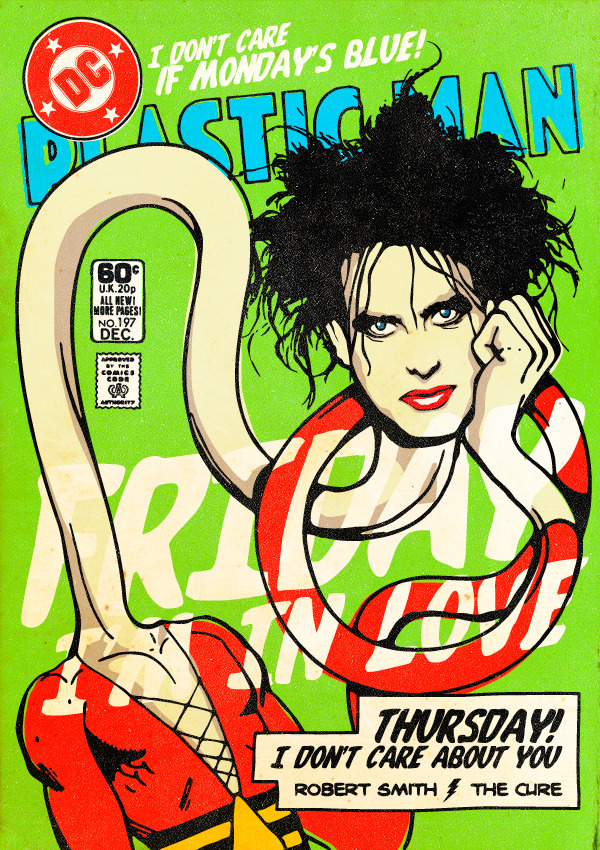
2013 “The Post-Punk / New Wave Plastic Man by Butcher Billy”

Click To Enlarge


What makes a pop culture icon?

"Would it be the effect of their contribution to a cultural movement? Is it the way they impact the time and the generation they are targeting? Or just how their exposure constitutes a defining characteristic of a given society or era?

As a child of the 80's I was heavily influenced by everything from saturday morning cartoons on TV to the music coming from the radio. Ian Curtis or Johnny Rotten are as iconic to me as Superman or Batman. Real people or imaginary characters, the incorruptible ideals of perfect superheroes or the human flaws and desires sometimes so desperately depicted in song lyrics - all of those influences affect us to the point of defining our character and personality, career paths and life choices.

The references we are exposed and specifically the ones we choose to absorb make us who we are. Who are your heroes?"
I really, really like most of Butcher Billy's choices for amalgamations, and I suppose Robert Smith's theatrically exaggerated personal style (specifically the epic hair) lends itself to Plastic Man. Still, we could have done better here. With the perpetual thick glasses and sardonic humor, "Eel" O'Brian and Elvis Costello might as well be relatives. As for repurposed lyrics, might I suggest "We slip through the streets, While everyone sleeps. Getting bigger and sleeker and wider and brighter." Regardless, I love each of the combined subjects, and am grateful for a straight Pliable Paladin instead of that goddamned Grant Morrison Jim Carrey crap. This a swell image that's I'd totally hang on the wall!

The Post-Punk / New Wave Super Friends

Monday, May 13, 2013

2010 “Huntress Gatheress” art by Gary Martin

Click To Enlarge


"Brush and india ink on 11x17 bristol."

Tuesday, May 7, 2013

2013 Captain Marvel “We Can Be Heroes: Might” silhouette by Steve Garcia

Click To Enlarge


“For every hero, there comes a day. A day when they step forward. A day when talk turns to action. Over 8 million people have had their lives affected by the hunger crisis in the Horn of Africa. It’s bad. And it hasn’t been this bad in over 60 years.

All of us at DC Entertainment are joining with Batman and the Justice League and making a stand. Today is the day we fight.”

More at http://www.wecanbeheroes.org/. Images courtesy of Bleeding Cool.com.

“We Can Be Heroes”

Sunday, May 5, 2013

2012 “Darkseid Eats” art by Kyle Latino

Click To Enlarge


"Based off the painting by Francisco Goya, Saturn Devouring His Son."
Kyle Latino

Tuesday, April 30, 2013

Talon #1 (December, 2012)


Hearing that the Batman had brought down the Court of Owls, Calvin Rose returned to Gotham City to see if he truly was free. Entering their headquarters, Rose set off an alarm that drew the attention of two very interested parties. The first was a female undead Talon, who survived several killing blows in combat with Rose. Calvin finally stopped her by stabbing the Talon through the head and shocking her brain with the conducted electricity of a Taser. The second interested party was Sebastian Clark, who killed the still twitching Talon by pouring liquid nitrogen on her head. Clark then took the injured and soon unconscious Rose back to his secret lair.

Erastus Clark had written a book called "The Secret History of the Court of Owls: The Truth Behind Gotham's Most Frightening Folk Tale." He and everyone else who had ever come into contact with the book were murdered, except his son Sebastian, who survived under an alias with the sole remaining copy. Now aged, Sebastian Clark had used his technology and connections to learn more about the Court of Owls than any man alive. While the Batman had struck the cultish operation a hard blow, they would surely recover unless the offensive was pressed while they were weak. Despite his protestations, Calvin Rose was eventually convinced to do what Sebastian Clark himself could not-- act as the agent of the Owls' destruction, "Ripped apart by one of their own talons..."


"The Gotham Trap" was by James Tynion IV & Scott Snyder on story, Guillem March on art. There's a phenomenon with TV show pilots where the creators put all of their heart and soul into that positive first step, then totally stumble on the second. This was that. Picking at threads from a Batman Family crossover like a vulture snacking on a corpse, the heroic Talon battled a villainous Talon again as they talked about how secret and unbeatable the Court of Owls were some more. An arch exposition spewing supporting character was thrust into the narrative as good Talon acted like an idiot to maintain trumped up drama. Despite reams of exposition, I as a non-Batman reader felt like I was missing important details that the writers assumed I should know, despite this being a solo series that I had read every issue of to this point. The artist only got to draw three characters in this story, and I got tired of looking at them after a while. In the end, good Talon finally accepted his life's mission, which I thought he'd already done in #0, as well as donning the horrible official Talon costume I'd forgotten he was stuck with because he looked decent for two issues without it. This comic effectively undid all the good will built up by the debut.

New 52's Day

Wednesday, April 24, 2013

Warner Brothers versus Marvel Studios


Pulp heroes like Tarzan preceded comic strip heroes like Flash Gordon and Dick Tracy in becoming movie serials. It wasn't until 1941 that comic book super-heroes began appearing with Adventures of Captain Marvel. Batman and Captain America, along with several other now forgotten long underwear types, had years worth of head start on Superman. However, 1948's Kirk Alyn-starring Superman was just about the biggest serial ever, followed by Atom Man vs. Superman in 1950. The serials were dying out though, so Superman and the Mole Men was released as a feature film the following year, and then the whole shebang was moved to television with Adventures of Superman (1952-1958.) By that point, DC Comics was essentially the only game in super-heroics, and their properties dominated the airwaves throughout the 1950s-1970s.


Marvel Comics began to erode DC's heroic hegemony in the 1960s, but didn't offer truly noteworthy competition until the live action Incredible Hulk (1977-1982) and the various animated Spider-Man series. DC maintains a relative monopoly on live action television shows, but has been in constant conflict with Marvel for cartoon viewers since the 1990s. DC had the prestigious, well written, fluidly illustrated Bruce Timm shows, and Marvel had a flood of clunky fan-baiting crap, which was nonetheless perfect for the Chromium Age viewership. Marvel had considerably more trouble breaking into feature films, lacking the licensing power and recognition of DC. Where the first Batman and Superman films were boffo successes that paved the way for more four-color features, Marvel seemed bound to close every door DC opened, beginning with the notorious bomb Howard the Duck in 1986. It took another twelve years for Marvel to manage an actual (if minor) hit with Blade. In 2000, the X-Men arrived, and both features became trilogies. The sea change turned into a tsunami with 2002's Spider-Man, becoming a massively lucrative franchise. Other film companies had varying degrees of success with Marvel characters, but the true game changer was the formation of Marvel Studios to exploit their own properties, beginning with 2008's Iron Man. For the first time, the breadth of comic book "universes" had traveled with the characters into the cinema, allowing Marvel properties to support one another, and providing a consistency of quality supervision.


With Marvel's The Avengers earning 1½ Billion Dollars, there's been a major push at Warner Brothers to replicate that success. This forgets that The Dark Knight Rises made $1.1B the same summer. I've often taken the WB to task for fixating on Superman and Batman at the expense of all other DC properties, but there's something to be said for that focus. Besides keeping those characters vital and highly profitable for much of the past seventy years, Warner Brothers have so mythologized their role in popular culture that their films are increasingly approached as art. The pedigree of their directors and the operatic scope of their films are deemed worthy of Oscar attention. Marvel Studios want to be your friend-- they're funny and hip, but are they truly timeless? Personally, I liked Thor well enough on first viewing, but found it a tiresome, lightweight Superman 2 retread on home video. I watched Captain America: The First Avenger three times at the theater (with the specific goal of matching my previous inadvertent most seen projected film, the 1989 Batman) and several more times at home. I remain quite content with it, but is that because I have so much more love for that character, or perhaps because the Star-Spangled Avenger is the closest thing Marvel has demonstrated to DC's grandeur? On the other hand, I've liked the Iron Man movies in first run, but have found my appreciation grows through repeat viewing (my girlfriend throws them on all the time) and retroactive relevance. For instance, I hated Scarlett Johansson in Iron Man 2, but the improvements made to her character and performance in Avengers make me appreciate Black Widow more in her first movie through continuity.


That having been said, I see major problems in the future with Marvel's approach. At some point, Robert Downey Jr. is going to retire as Tony Stark. So far, a substantial amount of the appeal of the Marvel Movieverse has been based around personality, most specifically his. Marvel's The Avengers is a great film because Robert Downey Jr. got to bounce off of Chris Evans, Mark Ruffalo, Chris Hemsworth and Samuel L. Jackson, just as what makes the Iron Man movies is his repartee with Gwyneth Paltrow, Don Cheadle and the rest. Take Downey out of that equation, and do you really care about what these guys get up to? The "Phase Two" pictures are focusing more on the individual heroes' stories, but with the origins and build up to forming the Avengers dispensed with, how strong are the properties on their own? Captain America has the benefit of being a defacto S.H.I.E.L.D. movie and quasi-sequel to The Avengers by carrying Nick Fury, Black Widow, Maria Hill and even Jasper Sitwell with him. Thor has... the Dark Elf? Guardians of the Galaxy are relying on James Gunn, which should hopefully allow them a Joss Whedon style commercial victory for signing a cult favorite, but there's no guarantee in that. I must also confess that they went and killed my absolute favorite character of the entire Marvel Movieverse, Agent Phil Coulson as played by Clark Gregg. Knowing that Coulson won't be in any more movies is honestly and surprisingly a blow to my enthusiasm for the whole franchise, plus I now have this strange urge to watch episodes of The New Adventures of Old Christine.


Marvel Studios' approach owed a lot to Fox's X-Men films, which are themselves struggling to reinvent themselves. They've retained Hugh Jackman's star-making turn as Wolverine, and fortunately for the studios, his charm has never seemed to carry him past playing Logan again and again. However, Wolverine is a physically demanding role, and Jackman's getting older, plus he's associated with some very unloved installments of the franchise. The X-Men are sold as an ensemble, and has already proven capable of swapping characters and actors in and out in a way I'm not confident Marvel could with their Avengers. Wolverine is bigger than Hugh Jackman, so while I'm sure he's welcome to the part long term, you can get another surly, charismatic, well-built actor to portray Logan and still have a guaranteed audience. Further, Fox is rebooting their half-hearted Fantastic Four franchise, so even after losing the rights to Daredevil, they still have plenty of material to start their own cinematic universe of Marvel characters.


Marvel's biggest, easiest sell of a character remains Spider-Man, which Sony retains the rights to. The approach to the Spider-Man movies have been more grand, so while I wouldn't count on seeing a Black Cat spin-off anytime soon, Sony will continue to draw eyes to their Web-Slinger, who will inevitably compete with both Marvel and Fox for blockbuster dollars. Sony also proved with their soft reboot The Amazing Spider-Man that despite comparatively softer returns, they could return to the web-slinging business much more quickly after the broadly disliked Spider-Man 3 than Warner Brothers could after Batman & Robin or Superman Returns stunk up the place. Sony could even mingle Ghost Rider in there, not than anyone's dying to see that, but it could be a bridge to a darker franchise involving characters like Venom, Morbius and Carnage.


Warner Brothers has faced a lot of criticism for their handling of the DC Comics heroes, especially in light of how well the Marvel characters are doing across three other studios. They're also the people that brought us Supergirl, Steel, Catwoman, and Jonah Hex, besides running Superman and Batman aground at various points. To my mind, Green Lantern was their greatest recent failure. It was clearly an attempt to create their own Iron Man, but with none of the passion or clarity of vision that launched Marvel Studios. Instead, disinterested hacks had gobs of money thrown at them, and the first legitimate attempt to expand the DC film universe beyond the World's Finest duo performed poorly enough that everyone involved seem to hope it will simply drift out of the public consciousness. Curiously, it reminded me a lot of that first disastrous Marvel movie, Howard the Duck, from the casting of Tim Robbins to the scattershot tone to the poorly played thin characters to the visual excess... all in service to a formulaic plot. Nothing seemed left to chance, with a script worked over into a safe, dull patchwork of tropes that failed to connect to an audience. Warner Brothers adopted all of the trickiest aspects of the Marvel shared universe and botched the execution of all of them. It's frankly terrifying to think of their attacking the Justice League property with the same mercenary, misguided zeal.


I'm personally disdainful of two out of the three Christopher Nolan Dark Knight films, but I think that even if Warner Brothers could manage to properly replicate the Marvel Studios formula, they would still be just one of several studios trying to produce that same sort of super-hero movie. Richard Donner, Tim Burton and Christopher Nolan defined the Warner Brothers approach of treating comic book properties respectfully as a form of modern mythology, while Sam Raimi successfully applied that interpretation to Sony's Spider-Man films. The three super-heroes chosen as their subjects are inarguably among the most important in popular culture, and by taking them seriously, this trinity have risen above all others in longevity, relevance, and of most concern to studios, profitability. Zack Snyder approached Watchmen with a similar aesthetic, and while that property lacked legs with the general public, signs point to Man of Steel being something truly special under his hand. For gods sakes, they have a completed script for a Wonder Woman movie by Joss Whedon sitting in a drawer, so what exactly is the hold-up in getting a director and filming one of the only other characters that could compete on a world stage with Superman and Batman in recognizability?


At the same time, Warner Brothers has to understand that the Flash, Aquaman, Martian Manhunter and most of their other properties have been consigned to Super Friends and Justice League reruns for years, with far less of a resonance than most Marvel characters. They don't have to spend a fortune on each of them, but they will need to take chances and recruit daring, committed filmmakers to make properties such as those resonate with modern audience (with Guillermo del Toro's Dark Universe being an excellent initial step.) I think that Warner Brothers should allow Marvel to have its day, since the inter-dependency of their movies will likely feel structural stresses as their current actors age, falter or price themselves out of service. Marvel Studios can't reboot any one of their properties without having to restart their entire universe, and they don't have the strength of a Spider-Man or Wolverine to fall back on if Iron Man doesn't fly with, say, Jesse Eisenberg under the hood. I feel it's best for Warner Brothers to take the long view, to set aside the time and effort to make each of the best loved DC heroes work in their own individual features. Then, when the heat of Marvel's moment has passed and they're trying to figure out how to make things work on tight budgets with lesser actors and characters, Warner Brothers can blow everyone's minds with an epic, sturdy Justice League film to bowl over the next generation of viewers. In the meantime though, how about that awesome Wonder Woman already?