Sunday, July 28, 2024

Comic Reader Résumé: Late August, 1986

Click To Enlarge


I liked Elfquest well enough when I read it, but I didn't pick it up regularly, and they all tend to run together in my memories. It doesn't help that I also read this material in the oversized collections you could check out from at least one of my school libraries. I read #14-16 some way, but aside from a moment here and there, there wasn't enough worth talking about worth bringing up. This third one though, I remember all too well, and may have contributed to my not keeping up with the monthlies. "Noisybad Highthing!" introduced these little multi-colored flying fairies with a very distinctly annoying speech pattern. They vomited sticky Spider-Man web fluid at people, and made victims hibernate for years at a time once encased in it. They fit that fairy tale sweet spot of being adorable to some and creepy to others, more the latter for myself. But Elfquest was also, in modern parlance, "horny on main," so that might have kept me coming back. Numerous pages were spent on two sets of half naked couples in some stage of getting their freak on, so despite being on the newsstand, the book did not carry a CCA approval stamp.

Embarrassing as it is to admit now, especially in light of the fantastically rendered headshot cover on The Mighty Thor #373, but in 1986, I couldn't easily tell Sal Buscema and Walt Simonson apart. I mean, if you put a Buscema Spider-Man and a Simonson X-Factor in front of me, sure, but they were similar enough on Thor to confuse me. The same subject matter and super-distinct work of the greatest letter of all time, John Workman, worked to muddy my perceptions. The book just kind of looked the same to my still developing eye for art styles. And it's not like I was regularly following the construction yard adventures of Sigurd Jarlson, which fairly screams "we're clear tired of the dual identity bit, but are unwilling to leave the safety of the familiar." The majority of this book involves Norse Gods babysitting other people's children. It was not my scene. But the last few pages drags Thor into the Mutant Massacre crossover, because I guess they figured to use a sales bump, or the Simonsons were just so deep into the plotting of more central books that it just spilled over. But yeah, a frog from the New York sewer told Thor about it while he was hanging in the park, and next thing you know, Angel's getting his wings pinned by harpoon. My half-brother bought this one a bit after the fact.

After utterly failing to live up to the hype, X-Factor #10 takes this bland, vestigial X-title and returns it firmly to the fold at the start of the Mutant Massacre and Walt Simonson's run as artist. If that wasn't enough, it's also a Marvel 25th anniversary cover with a Cyclops head shot and the well regarded gray border filled with Marvel heroes. Once again, I didn't buy it myself, but my brother did, and he loved it. I think Louise Simonson and Bob Harras knew the title needed a kick in the pants, so taking part in the first big X-title crossover, much less one with a huge body count that this specific issue contributes mightily to, was just what editorial ordered. We've got your Morlock tunnels lined with bodies, the Marauders, Sabretooth, Apocalypse, and it all ends with Angel's wings impaled to a wall. The kids were more responsive to this than Beast going clothes shopping, let me tell you.

Cracked #224 is scanned onto the Internet Archive, so I can confirm that I owned the issue, but I already had a good run at this magazine last month. It still looks pretty bad, but they've go some notable creators. Dan Clowes did an Ugly Family installment, Peter Bagge did a single page gag with Bill Wray-- I never realized how many '90s indie guys I dug were on this book first doing booger jokes. There's a Born in the U.S.A. cover and a Billy Idol on the back, both crossed with Sylvester the Janitor. There's a Cosby Show parody, and pop star Garbage Pail Kids, and this whole ninja mail order catalog thing. Whatever. Moving on. Unfortunately to Mad Magazine #266, which also took on Cosby, and they both took extended digs at Hands Across America. It was such a dumb idea. Other satires included Who's the Boss, Growing Pains, and Wheel of Fortune. Mad had all the guys that you associate with this type of mag, like Mort Drucker, Don Martin, Sergio Aragones, Dave Berg, Will Elder, Harvey Kurtzman, Angelo Torres, Jack Davis, and Al Jaffee. I don't think either title holds up, but at least Cracked was more visually fresh. Mad's art staff was more than a little long in the tooth, and the only way I can tell that this isn't a '70s issue is the subject matter.

I've been thinking recently about how utterly amazing the work of Bill Sienkiewicz was, especially in this period. But as a kid, I wanted nothing to do with him, and he was perhaps the first penciller that I outright hated. I've never been a Bob McLeod guy, and my tolerance for kid heroes is limited, so suffice to say I tended to avoid New Mutants like the plague. At one time, it was enough to be X-Men adjacent to score top ten sales status, but with more related titles and stronger competition overall, the X-office needed to run a tighter ship. Of course New Mutants #46 would tie into the Mutant Massacre, but more than that, we'd get at least one crossover per year thereafter to keep that ship afloat. Barry Windsor-Smith was doing their covers in this period, and this has to be among the worst of them. The X-Men and a bunch of Morlocks burst through a wall in the X-Mansion, to the surprise of the barely present titular leads. It looks like it should be an interior half-splash, especially with Colossus being given a dialogue balloon, plus it was the umpteenth variation of "you X-Babies clear out so the adults can get the actual work done." The interiors were by Jackson Guice and Kyle Baker, an interesting combo that I found far more palatable than previous art teams. Not the main thrust was that the X-Men had evacuated the homeless mutants being slaughtered en masse by the Marauders back to their pad, now serving as a makeshift medical ward. Please don't ask me to explain the logistics of people who, if I recall correctly, lived in the sewers on the island of Manhattan, walking in one night to upstate New York via those same sewers. Besides, more pages are devoted to the New Mutants characters that I was largely unfamiliar with muddling in their own affairs in the periphery, contributing nothing. In the end, the bugger off to fight the evil father of the techno-organic alien member that they'd adopted, so they couldn't even be bothered to battle a mutant during the Mutant Massacre. I can't even blame my brother, because I bought this one, but not the next.

Psi-Force #2 picked up where the first issue left off, with the runaways carrying their dead mentor's body, wrapped in a stolen rug, around downtown San Francisco. They're trying to get it back to their shelter, but face a Warriors' style gauntlet in completing that task. Hilary Barta and Romeo Tanghal don't compliment Mark Texeira as well as Baker in the debut, but it's still a much more attractive and contemporary looking title than most of the New Universe's offerings. Steve Perry juggles a lot of nefarious parties of interest pursuing these kids, with a steady ratcheting of tension. He's much better here than on the abortive Blackthorne Omni-Men series, and this book didn't live up to the potential established in his two issues for the rest of my time following it. But I did enjoy the title enough to stick with it for a while yet.

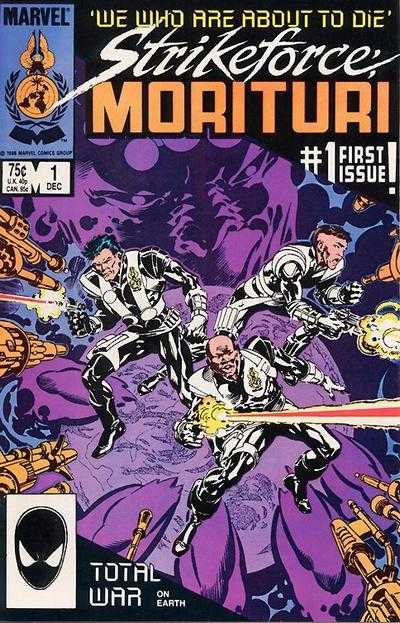
I recollect tossing through Strikeforce: Morituri #1 at the 7-11, but not picking it up. Like many of my generation, I have to fight the Mandela Effect of associating it with the New Universe, since it was developed for that line and released at the same time with a similar trade dress. Instead, I was given my brother's brother's laminated-cover copies of the first three issues. So possessing personally gimmicked editions, I of course finally read the things, and I thought they were swell. The premise was that aliens that were a cross between the Predators, the creature from Explorers, and the enthusiastic consumerism of E.T. began a reign of terror over the Earth. They mostly acted like raiding parties in old westerns-- dropping onto towns, raping and pillaging, collecting slaves, and slaughtering anyone who got in the way. Humans were initially powerless to stop them, until a scientist developed a procedure to literally empower people. The Morituri process first gave a subject superhuman strength to endure the rest of the process, and then the subject would develop superhuman abilities. The first group were a trio called the Black Watch, who died valiantly taking out the leader of the alien's campaign against Earth. They were immortalized in comic within a comic, and their story inspired more volunteers for the procedure to take the fight back to the invaders. The catch was that the Black Watch was originally supposed to be a quintet, but two volunteers died while their powers were being developed. A third spontaneously combusted, accidentally killing a fourth in the process. The human body simply couldn't sustain the Morituri process for long, and anyone who undergoes it were expected to die badly within a year. If I recall correctly, the book ran in real time, unless that ol' Mandela Effect is acting up again, mixing it up with the New Universe or The 'Nam. Regardless, all of the characters introduced here should be dead by the twelfth issue, and the book is as much about how they deal with their imminent mortality as it is about using their powers to fight the aliens. 1986 is considered by many to be the greatest year in comic book history for mainstream content, with the much heralded works of Frank Miller and Alan Moore taking up most of the oxygen. The Strikeforce: Morituri got something to say. At the end of the day, it's still a sci-fi melodrama most indebted to Chris Claremont, but Claremont rarely operated at this level. I'd argue it as a career best for Peter B. Gillis and Brent Anderson, aided by the shine of a newcomer inker named Scott Williams. The inker's buddy drew the comic-within-a-comic, and While Portacio would soon offer a few fill-ins to establish himself as a penciller. Even the late Jim Novak is reminding me that he rates high ranking among the best letterers ever.

Sunday, July 21, 2024

Comic Reader Résumé: Early August, 1986


My reading of books published in August of 1986 starts with a belated comic. I got Batman #401-403 is a three pack together, and I believe that it was from a toy store this time? Maybe another deal like that Man of Steel partial set with the cardboard envelope at Circus World? Despite still considering myself a Batman fan in this period, as with Superman, I had never made much of an investment in the hero's comics adventures up to this point. Their Pre-Crisis solo outings mostly bored me, but these stripped down post-400 Batman logo treatments had that air of late '80s sophistication. Decades removed, this genre-embarrassed generic fontiness would get an immediate veto, but at this point gave the title a cool aloofness. I wasn't used to seeing John Byrne drawing DC characters, and Magpie barely qualifies, as she's a rarely seen again new villain with a rare penchant for voluntary alopecia. I'd turn to crime too if I had to maintain three separate Mohawk hairstyles simultaneously on the same head. But anyway, getting past the Byrne, you had admittedly rough and rushed Trevor Von Eeden interiors, coming off the failed Thriller series. He'd drawn what is still one of my favorite Batman things ever, the 1982 Annual with Ra's Al Ghul, and his minimalism just played into that "yes, it is a Batman comic, but we don't care if you know that" vibe. Von Eeden was the original artist chosen for Year One, before being replaced by David Mazzucchelli, and there's a continuity between their Tothian styles. I'm not sorry things worked out as they did, since Mazzucchelli was at the peak of his powers on a story that remains a high water mark for the medium nearly four decades on. But if I may be so bold, I can't say Von Eeden wouldn't have had at least a similar impact, and he manages to convey a real menace in Magpie that nothing about her name, look, or modus operandi would suggest she could pull off otherwise. It's a little insane to me that there's a Brian Bolland pin-up at the back of this thing, that may well have been intended for the cover, and it's the least visually striking element of this package. "The New Adventures" branding is many months out, but Barbara Randall's edgy story suggests the attitude well in advance.

This is the last week of launch titles for the New Universe line, and it's probably not a great sign that I went to read the first issue of Displaced Paranormals, or D.P. 7, and realized that I'd already read it in recent weeks but forgotten. It had a police line-up cover that was like Love & Rockets on Lithium, and was about a more mundane but diverse team of X-Men who run away from the School for Gifted Youngsters when they found out Professor X was going to lobotomize and sell them out to the C.I.A. I was never that into the late Paul Ryan, and gave this book a pass on art alone, but my brother bought it, so I eventually read his.

On the other hand, I did buy Justice #1, which was more of a New Universe breaker than Star Brand, which took all the heat. Created by Archie Goodwin and Walt Simonson, Justice borrowed heavily from the Terminator, featuring a tall, well-built New Wave Punk in a trench coat with glowing red eyes who wanders around Alphabet City killing other punks, seemingly indiscriminately. Simonson bailed as soon as the development money ran out, but Goodwin had a staff editorial position, so he was stuck teaming with young artist Geoff Isherwood to get the book out. Isherwood was more in the Neal Adams vein, and therefore my own, plus I wasn't hip enough to know Justice's whole scene was derivative and years out of date. It helped to cover that this was actually a stealth high fantasy series, with the silver-mulletted quasi-knight Tensen having been exiled to Earth from another dimension by magical ninjas after his affair with the queen was discovered. With patchy memories and no clear way home, Tensen uses his ability to see the auras of others to judge good versus evil. His right hand is a "sword" that fires destructive energy to reduce to ash any wicked that Tensen finds, while his left hand is a shield that erects force field squares to protect those deemed innocent. And again, since Star Brand was comparatively morally and structurally complex, the Justice vigilante just goes from drug dealer to pimp and so on, killing all the bad ones, and learning of the joys of hot dogs paid for in blood. All inked by Vinnie Colletta, looking like Jim Mooney doing a Death Wish comic. So it was dumb and violent when that was the style of the time, and I'd be back for seconds.

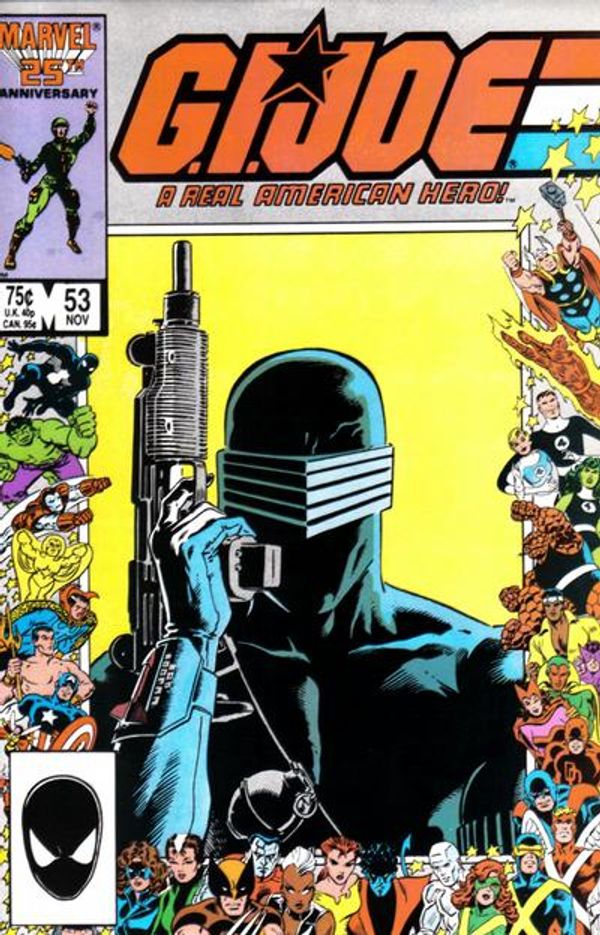
The cover to G.I. Joe a Real American Hero #53 is a Mike Zeck Snake-Eyes head shot, and I bought it on a t-shirt just this year. Hey, it's a chest-up, and he also draws a forearm holding up an Uzi. Within the parameters of the assignment, Zeck went above and beyond. But also, Snake-Eyes isn't even in this issue. "Pit-Fall" is about Cobra forces assailing the headquarters of G.I. Joe while the team is on suspension and the actual members are off-site. It's mostly about older brass who were deliberating on the Joes' fate being put in the position of having to replace them. But more importantly, it was a Flint spotlight issue, as he and Lady Jaye are two of the few members in the area, and Flint sacrifices himeslf to make sure his best gal could serve the greater good.

Uncanny X-Men #211 was the proper launch of the Mutant Massacre crossover, with another iconic JRJR Wolverine cover, this one a close-up of popped claws and frayed mask with a Marvel 25th anniversary border. Not being well versed in detecting art styles, I just assumed Romita had done his usual work on the interiors, though it's now obvious Bret Blevins provided a fair share of the pencils on this issue. Credit to Al Williamson for keeping the overall look consistent, though I was easily distracted by all the murder the Marauders were up to, followed by the X-Men getting ripped to bits trying to stop all that murder. We lapped this up in the '80s, but I admit that it's harder on the system at middle age to watch all this wholesale slaughter as entertainment. Honestly, it was much more abstract and fanciful back then, before you could watch videos of actual atrocities online. Given how much I and much of my generation hated Blevins' New Mutants run, looking at these pages, it's kind of a shame that he didn't get the Uncanny assignment instead. Objectively, Blevins was great at drawing awkward teenagers, where Marc Silvestri would have sexed them up like he did the kids in X-Factor. However, I don't care about New Mutants, and Blevins would have been a smoother transition from Romita. I'll also point out that this issue offered The Marvel Mutant Massacre Map, with Walt Simonson doodling in Beast, Nightcrawler, Angel, and one of the Power Pack kids while detailing the reading order of the sprawling 11-part, five title crossover. This was an extremely successful and well regarded event story that led to Marvel having their entire line of $4 books loosely connect for months on end today. This entire event cost barely more than two of those modern books, and involved three closely associated writers. We've lost so much common and story sense in the intervening decades.

I don't have the time or interest to go back and read all of these comics, but for various reasons there are a number of 1986 titles where I'm reading along with or ahead of this coverage. In the case of Classic X-Men #3, I bought an omnibus collection a while back, but I'm not sure when I'd ever read the thing without being prompted. I haven't had the slightest interest in the X-Men's modern adventures in decades, but I was deeply invested in the mutants of this time period. Since the collection only reprints the newly created material, as it progresses, we're talking about an investment of 6-8 pages a month, though they're written by Chris Claremont, so that's only about 48 pages worth of contemporary comics reading. Unfortunately, I waited three issues in to start. To make the original Len Wein issues more his own, plus to summarize a giant sized comic into a standard one, dozens of new pages were commissioned to, ironically, shrink the overall narrative. In other words, I went through pages 6-73 of the omnibus in service to following these "short" stories going forward. As it turns out, Dave Cockrum did come back for a lot of those interstitials, but he was so heavily embellished by Bob McLeod that I thought the inker did the whole page himself. Cockrum's work was already in decline by his second stint on X-Men, and we'd had the Paul Smith and John Romita Jr. runs since, so maybe that was for the best. I also didn't recall John Bolton's work being so impressionistic as I find it here, and in fact I now think I see a strong influence of this period's work on the artists Brian Stelfreeze and Jason Pearson, who are a few years out from getting published. Another head shot cover, this time of Storm. This issue involves the death and funeral of Thunderbird, but he was little remembered in this period, so commercial considerations exiled him posthumously to the inside frontpiece by Art Adams and Bolton's back cover.

G.I. Joe Order of Battle #1 started a four issue mini-series cover-billed as "The Official G.I. Joe Handbook," but drawing direct comparison with OHOTMU does it no favors. And it's in the drawings where it most comes up short, because instead of enlisting talented artists associated with both, like Mike Zeck, everything here is drawn by Herb Trimpe and Joe Delbeato. Simply drawing 32 Joes in full body static poses could be numbing for a set of artists, much less the same two guys, and they're rendered in an oddly passive manner for a bunch of rugged soldiers. Besides the lack of visual variety, there's no sourced reprint images to break things up, just one figure per page insides a file folder shaped box. The order is also rigid, listing only heroic Joes in alphabetical order for two issues, a third just for Cobra, and the fourth all vehicles. They don't even maintain the single creative team policy, because Eliot R. Brown does the vehicle issue by himself. Greater stylistic liberties are taken with Cobra, and they're just visually more dynamic in general, so it really would have broken things up to mix them and the vehicles in with the Joes. In my case, it was a fatal error, because I was so bored by the first issue that I didn't go back for more. Larry Hama was in file card mode, maybe offering an extra paragraph on top of what could be found on the action figure packaging, and far too fixated on dry data like what weapons they'd trained with, vehicles they were cleared to operate, and so on. The one almost backhanded compliment I can give is that I think Trimpe was enamored with Paul Smith at this time, because most of these entries have a PMS vibe. I was also a big Smith fan in this period, but I'm not sure he's the artist to ape for this subject matter or the target demographic.

Friday, July 5, 2024

Comic Reader Résumé Podcast #24

(July 1986)


Internet ArchiveMP3Spotify

ré·su·mé [rez-oo-mey, rez-oo-mey] noun 1. a summing up; summary. 2. a brief written account of personal, educational, and professional qualifications and experience, as that prepared by an applicant for a job.
In Comic Reader Résumé, I use Mike’s Amazing World of Comics to travel back through time via his virtual newsstand to the genesis point of my lifelong collecting of comics. From there, I can offer a “work history” of my fandom through my active purchasing of (relatively) new comic books beginning in January of 1982, when my interest in the medium went from sporadic and unformed to routine on through compulsive accumulation. To streamline the narrative and keep the subjects at least remotely contemporaneous, I will not generally be discussing what we call back issues: books bought long after their publication date. Sometimes, I will cover a book published on a given month that I picked up within a year or so that date, and I give myself an especially wide berth on this aspect in the first couple of “origins” episodes. We’ll get more rigidly on point as my memories crystallize and my “hobby” spirals out of control into the defining characteristic of my life (eventually outpacing squalor and competing neuroses.) It’s part personal biography, part industry history, and admittedly totally self-indulgent on my part.

This episode includes Alpha Flight #39-40, Captain America #322-323, Casper #225, Classic X-Men #2, G.I. Joe a Real American Hero #52, Mark Hazzard: Merc #1, Marvel Saga #11, The Official Handbook of the Marvel Universe Deluxe Edition #11-12, Psi-Force #1, Richie Rich #219, Son of Ambush Bug #4-6, Super Powers Vol. 3 #2, Uncanny X-Men #210, X-Factor #9, and more!

“Transcripts” Alpha Flight, Big Trouble in Little China, Captain America, Cracked, DC Comics, G.I. Joe, Marvel Comics, New Universe, Pac-Man, Spider-Man, Super Powers, Wolverine, X-Factor, X-Men, Atari, Maximum Overdrive, Movies, Music, Q*bert, Superman, Video Games, Comic Reader Résumé

Sunday, June 30, 2024

Comic Reader Résumé: Late July, 1986

Click To Enlarge


Marvel Comics had decided to celebrate its quarter-century anniversary, as marked by the publication of Fantastic Four #1 in the summer of 1961, a couple of different ways. One was a now-iconic gray border around select covers featuring style guide friendly versions of their top characters smiling at the readers as they encircled a different close-up head shot of the book's star-- probably at a reduced rate for that artist. You see, Cadence Industries had been the parent company of Marvel since 1968, but would soon be liquidated, with Marvel being prepped for sale. Corners were being cut wherever they could, with the greatest impact on the other element of the celebration-- the launch of a new imprint. Editor-in-Chief Jim Shooter may have saved Marvel Comics, and even the mainstream comics industry, by whipping it into professional and corporation-appeasing shape in the late 1970s, but he broke an awful lot of eggs making that omelet. He developed a reputation for being cruel, capricious, demanding, and egocentric. For instance, earlier today, I was reading about how classic inker Chic Stone was recovering from a heart attack when he was greeted by a letter of termination from Shooter. Favorite son John Byrne had just left the company specifically because of Shooter, after both had proven their loyalty by testifying against Jack Kirby in his lawsuit for the return of his artwork and intellectual property. The boss man had also awarded himself the massive royalties from writing the event maxi-series Secret Wars, and was driving everyone nuts nitpicking tie-ins to its broadly reviled sequel.

There had been months of cryptic hype, with a series of house ads by Cynthia Martin showing a cosmic bolt traveling the solar system to strike the Earth, about what was known inside the industry as "The Shooterverse." In a n notable editorial, Shooter explained that this would be a line of adventure titles unconnected to Marvel continuity that would better reflect "the world outside your window." But again, within the industry, it was known as a boondoggle thrown together by moonlighting editors after hours for no money after the budget was slashed, on books staffed by unknowns and the exact types of aging veterans Shooter had been running out of Marvel for years prior. Whether through circumstance, incompetence, or intentional sabotage, this New Universe was seen as a monument to Jim Shooter's hubris whose failure would be ecstatically celebrated within the industry.

But I was just a kid looking at the new comics at 7-11, knowing nothing of this beyond what Marvel's promotion had told me. According to Mike's Amazing World, there were two titles offered on the launch week. Spitfire and the Troubleshooters #1 was an immediate pass. I didn't know what a spitfire was, besides the clunky fire engine red robot on the cover. I didn't know what troubleshooters were either, but the dorks hanging off the robot had big TSR-80 Wiz Kids energy. The last straw though was the old-timey artwork by Herb Trimpe, not drawing in his more modern G.I. Joe Special Missions style, which wouldn't have worked with the Silver Age inks of Joe Sinnott anyway.

Better odds were with Star Brand #1, for which star artist John Romita, Jr. had quit The Uncanny X-Men in an act of solidarity with Mein Kapitan. This was the only New Universe title that Jim Shooter himself wrote, about a guy who in most ways resembled Shooter himself, as a writer-insert. Blonde motorbike Shooter stand-in met an old man in the woods who gave him cosmic power tied to a sort of movable tattoo that was blatantly swiped from the Eclipse Comics moon & star colophon. Besides ridiculing the Marty Sue lead, critics also pointed out that the scale of the Star Brand's power, and his fighting a tentacle-alien that wielded laser rifles and wore power armor, was a pretty big leap past the grounded reality that was being forced upon every other book in the "Shooterverse." I wasn't yet adapt enough at recognizing art styles to notice that this was a penciller that I had been enjoying elsewhere, plus that first issue was very heavy on mundane character interaction. Worse, the Star Brand's power set and goofy alien foe recalled the Superman comics that I had rejected in my youth. Probably the worst was the cover, where inker Al Williamson had obliterated any trace of Romita's style to show the hero floating in space... just like a typical Superman image. So I put it back, and only dug the run out of the quarter bin of Marauder Books in 1989. The New Universe was failing to launch.

Two more New Universe titles arrived for the fourth week of July. Nightmask #1 was another pass. While the cover image well communicated that our hero was a teen who, with the helped of his wheelchair-bound sister, could cast himself as a black-leotarded sleepy-time hero into dreams... it also looked like a Mad Magazine parody of something like Dreamscape. Once again, I didn't know what a night mask was, so the pun was lost on me, as was any appeal from the fay and unimaginative silhouette costume. Once again, writer Archie Goodwin had normal people in plain clothing talking way too much to overcome the generic fantasy ogre when it finally came time for battle. Tony Salmons was never a fanboy favorite, so having him inked by the also unloved Bret Blevins was like a Vegemite and sardine sandwich. It was as if when Shooter stole the Star Brand from Eclipse, he also tried to take their Marvel Lite company-owned titles like The New Wave and Freedom Project. I only got a few of these out of the quarter bin.

Psi-Force #1 finally broke the New U's unlucky streak. I can usually spot Kyle Baker's inks from a mile away, and there are traces here and there, but he exercised an uncommon fidelity to Mark Texeira's line that I approved of. I'd encounter Tex here and there over the years, but this was the book that finally got my full attention. Steve Perry's story was very indebted to Stephen King ESP-infused thrillers like Firestarter, Carrie, and The Dead Zone, though some of that may have been under the orders of co-creators Archie Goodwin and Walter Simonson. A rogue C.I.A. agent uses his paranormal abilities to gather together five similarly gifted teenagers before they can be recruited or killed by various nefarious organizational entities. He's killed in the process, but his likeness is seen in a gestalt being periodically generated by the kid's combined abilities. This "Psi-Hawk" was heavily indebted to the Infinity Man of Kirby's Forever People, or more recently the phoenix from Gatchaman and the Lion Force Voltron. Psi-Force wasn't the only contender for the slot of X-Men in the New Universe, but as an X-Men fan, I thought it was off to a pretty good start in clenching the title.

My half-brother's mother was adopted from Ireland, and he always made a big deal about those roots, so that may have contributed to his buying Web of Spider-Man #20, with Peter Parker reporting on the IRA.

After a couple years' worth of irregular and parasitic reading, I finally returned to buying Captain America with #323. It was another one of those Marvel 25th anniversary head shots, and I was always a sucker for a grinning Cap. I still struggled with Paul Neary's art, one of the main reasons that I wasn't keeping up with the book, but I was intrigued by the premise of "Super-Patriot Is Here." Mark Gruenwald had been throwing a lot of ideologically-opposed opponents at Cap, but here was a guy that claimed to better represent modern America, and certainly a more crass and cynical one. I spent most of my childhood resting my head on a bicentennial pillow, and I considered myself patriotic, but maybe the jingoism of Reagan's America was starting to get to me? Or maybe I just thought Super Patriot looked cool, and I liked seeing Cap fight a guy who weaponized his own identity against him? Anyway, the storyline hooked me, and I'd keep up with it.

The third week of New Universe releases continued the batting average of the second. Kickers, Inc. #1 introduced a football player who gained super-abilities that he used to form some sort of detective agency with some of his teammates? Man, this book made Super Powers hold its beer. I responded way better to Mark Hazzard: Merc #1, which seems to have put me at odds with the buying public, as usual. I wasn't following writers at the time, but this was written by the same guy that had done "The Death of Jean DeWolff," and I think I appreciated that same darkly humorous streak. Rejoining Peter David, if only for the cover, was Mark Beachum, who brought a Punisher vibe at a time when I was probably suffering slight withdrawals. The interiors were by Gray Morrow, another aging industry veteran with a dated style that I'd had little, unwelcome exposure to. However, that gritty graphite look worked for a "realistic" war story, reminding me a bit of Gene Colan, and Morrow had made his biggest splash on '70s Warren magazines, so he knew the territory. But mostly, I just took an immediate liking to Marc Hazzard. He was a tall, stocky guy with thinning hair that reminded me a little of my father. Hell, they both even had a big wooden African tribesman shield on their walls, if you can believe it. They both also had a way with the ladies and an estranged son from a past relationship, but I doubt my father was helping to overthrow South Pacific dictatorships on his weekends like Marc. To me, this was kind of a perfect first issue, with a done-in-one story that sets up the entire supporting cast, a fair amount a sexual titillation and brital violence, sprinkled with humor, lots of teases of the lead character's backstory and foreshadowing his unique circumstance as a soldier-for-hire trying to reconnect with his child. It was immediately my favorite New Universe title, and easily came the closest to fulfilling the line's mandate. So of course it was treated as the bastard stepchild, and not only the first title on the chopping block, but also the series that ended only after killing off its titular star. Though in that regard, it did set a precedent. So I guess this also re-calibrates my batting average, because I'll end up following both the longest and the shortest lived New U titles, but only for part of their first year. Only year, in Marc's case.

Though it probably helps to have Silver Surfer, punk Storm, and black suit Spider-Man on the front of Sif to Sunspot, the front cover to The Official Handbook of the Marvel Universe Deluxe Edition #12 hardly misses a beat from losing Byrne in favor of Ron Frenz, already a brawny classical Marvel artist. A tough Buscema-style Namor on the back cover couldn't hurt, though. This issue struggles through a lot of group entries, but we also get Michael Golden, Art Adams, and Paul Smith.

Son of Ambush Bug #5 also got double-shipped this month, plus Keith Giffen had taken over the final issues of Hex, which might explain the four pages randomly drawn by Steven Bissette after the Bug bit Keith's pencil in half. Actually, "random" describes everything this issue, including how I came to it. I think I missed this one on the newsstand, and bought it newish off the rack of that baby comic shop inside the South Houston antique mall/flea market that we only occasionally visited. After repeating the opening gag of a magazine parody from last issue, this time Comic Buyer's Guide, we follow Irwin Schwab's imprisonment and kangaroo court trial for contempt of comics, with Two-Face serving as both defense attorney and prosecutor. We didn't say "meta" in the mid '80s, but the subtext has devoured the text, with the Bug serving as a stand-in for Giffen as he indicts himself for his inability to do what the fans want, and DC's unwillingness to let him do what he wants. The issue is a thinly veiled angry screed about how a character premised on being a Looney Tunes-style annoyance to Superman, who moves on to mocking the greater DC Universe, has been denied access to anything related to DC Comics. Notoriously, no one wanted to allow their heroes to appear in the upcoming funny Justice League relaunch, but Denny O'Neil took pity on the book and allowed the use of Batman in the earlier part of the run. After taking repeated jabs at the Superman office, it's telling that a Batman villain is the biggest "get" for this mini-series. We've forgotten about the Uh-Oh Squad, the government plot to use the suit's teleportation technology is abandoned in favor of a circular logic gag, Cheeks does a very on-the-nose DKR image followed by an uninspired Elmer Fudd lift, we're doing the Ditko objectivism as Kafka riff again, there's the tangent in the prehistoric Gorilla City-- it's just a bunch non-sequiters to fill out the page count. I know that the book was trying my patience now, there weren't really jokes to get, and the whole project seemed to sour. I think I saw the sixth issue on the stands, but lollygagged until it wasn't, and didn't complete the mini-series until I got it as a back issue from a shop in 1987. And even then, I think I'd tried the earlier, funnier mini-series, and loving that, finally resolved this one. I knew a lot of this went over my head at the time, but reading it as a comics-learned adult who's older than the creators were at the time, the series just makes me sad. Giffen was so bitter and lost, Robert Loren Fleming is barely hanging on in his anarchic scripting, and I shudder to think how things would have turned out for these talents if not for the breakout success of JLI. But I can say that I still really love the art on this thing, especially when Giffen would just draw some ugly weirdo in a panel for kicks.

Monday, June 24, 2024

Comic Reader Résumé: Early July, 1986

Click To Enlarge


When I was a little kid, other children's comic collections were filthy with Archies and Harveys. I'd dabble in the former, but I wasn't even that big a fan of the cartoons of the latter. I hadn't noticed, but Harvey Comics went on a four year hiatus, and returned with The Friendly Ghost, Casper #225. The cover announced, "Casper is back! You Asked For Him! Special Collector's Issue! Join the fun! With Harvey Comics!" It's the excess of cover hype that Son of Ambush Bug #1 had just made fun of, but I think it worked on me. They were just so excited to bring me more Casper, the dead kid from the genteel cartoon that played before the crack of dawn that I rarely watched. I recall nothing of the contents of that issue, and never bought another one. Heck, they did a cool looking revival a decade or two back that I did order, but they never came in, so even when I tried it clearly wasn't meant to be. Richie Rich #219 also came out that month, and also benefited from my FOMO. I could believe Casper was years departed, but I'd have sworn those Richie Rich digests were still lining the shelves of check-out lines. In animation, Casper hadn't appeared in much new since the early '60s, but that Silver Spoon brat had just come off a four season TV show in 1984, and how I despised his displays of affluence. His swindling me out of 75-cents for his pap did not endear me any further. Despite those two disappointments, I did feel a tinge of regret over skipping Hot Stuff: The Little Devil #165, the least recognizable but most fun looking of the three IPs. In retrospect though, shouldn't it have been Wendy the Good Little Witch in that third spot? Oh, and I only heard today that Marvel was going to take over publishing Harvey before the hiatus, and that the connections they made probably led to the creation of the Star Comics imprint. In fact, Harvey tried to sue Marvel for borrowing their laid off talent and design aesthetic, like that makes a lick of sense.

The Official Handbook of the Marvel Universe Deluxe Edition #11 offers the last John Byrne cover, likely owing to his defecting to DC over his differences with Jim Shooter. As with George Perez on the original Who's Who covers, it's too bad that one of the greatest artists in comics history couldn't complete the assignment of drawing every character in a particular universe's reference book running roughly two years. Also, they were each replaced by... not all-timers. But DC went with wild divergences in style like Paris Cullins, Ernie Colón, Joe Staton, Eduardo Barreto, Kevin Maguire, and yes, John Byrne, with moonlighting editor Dick Giordano not offering the same steadying hand as Josef Rubenstein. I give Marvel the edge on consistency. Appropriately enough, She-Hulk, Scarlet Witch, and Sasquatch are on the cover for Richard Rider to Sidewinder, and Byrne does each of their entries. Aside from Mike Mignola on Rocket Raccoon, the first half is blah, but then it kicks into high gear. Mike Zeck goes beyond with Sandman and Scarecrow, Mark Beachum elevates Scorpion, and Art Adams delivers on Sersi and Shadowcat. Paul Gulacy supposedly returns to Shang-Chi, but I think it might be misattributed, because it looks more like period Kyle Baker to my eyes.

Son of Ambush Bug #4 likely came off the stand at a 7-11, but my memory gets fuzzy on the back half of this mini-series. Not helping is the fact that the vague semblance of a narrative muchly resolves within this issue. The book opens up with a three page parody of The Comics Journal that also summarizes the mini-series to date. Argh!yle's Plan of Steel is thwarted by John Byrne's first refusal for usage of Superman elements in other books, and so the entire orbiting Bureau satellite is literaly blown up by DC's legal department. The Interferor's origin is revealed, he puts Irwin Schwab through the paces of a cycle of reboots, and then... recedes from the core narrative. This is the last time the Bug's infernal nature as an escapee from Hell is really referenced. Combat Cheeks and his Frontline Medics gets a mock cover and single page strip, but has pretty much run its course. This issue still has humorous intent, the next not so much.

I'm sure someone in the family had a copy of G.I. Joe a Real American Hero #52, featuring an awkward Quick Kick versus Storm Shadow cover, and the ninja's reconciliation with Snake-Eyes in the wake of his near-death experience. Also, Serpentor avoids an assassination plot against him to become a folk hero to the Legions of Cobra, and the Joe team's operations are temporarily suspended in the wake of the Battle of Springfield. Adult-me sees a lot going on here, but I think kid-me was bored of all the talky-talky.

The Marvel Saga, the Official History of the Marvel Universe #11, once again covered by Keith Pollard, thinks telling the first adventure of "today's X-Factor" is a bigger selling point than it probably was. Likewise, a cover panel devoted to Molecule Man, hoping for a Secret Wars boost? So we get Magneto, a little gold armor Iron Man, Thor vs. Molto, Fantastic Four vs. Rama-Tut, Human Torch vs. the Acrobat as a fake Captain America, Giant Man, Hulk vs. Space Phantom, Hulk quits the Avengers, and Iron Man upgrades to the red & gold Ditko armor. Finally, two major revivals from World War II-- a Nick Fury still capable of enjoying 3-D glasses, and ol' Adolph himself as the Hate Monger, both in Fantastic Four.

Ironically, I finally committed to buying Uncanny X-Men with #210, just as the John Romita Jr. run was ending and the Mutant Massacre would serve as a peak before a steady decline in my interest in actually reading the book. But that's a few months off, and this grim cover of battered mutants daring you to "C'mon, mess with us-- make our day!!" was more of a fever pitch moment. The silhouetted Marauders were murdering muties and their allies, beginning with a Hellfire Club security officer and a rainbow-themed Morlock. Beyond those bookends though, it was a pretty standard issue with a lot of set-up. A closeted and incognito Dazzler was positioned to return in an upcoming issue. Rogue faced a bigoted peanut gallery at Macy's. Kitty Pryde had another argument against a prejudiced mob, but managed not to drop an n-bomb this time. Magneto questioned the threat posed by the mutant-busting X-Terminators and a role offered within the Inner Circle while navigating Xavier's legacy as headmaster of the School for Gifted Youngsters. It was very ominous, and I lapped it up.

On reflection, it was my brother who got the hot ticket first issue, so I had to settle for Classic X-Men #2 off the newsstand. This was an augmented version of original X-Men #94, and I wonder if these supplemental pages by original inker Bob McLeod ever got reprinted themselves. The Danger Room montage page from the old comic is expanded to two pages of sequential action, then there's a page with Cyclops having a meeting with Professor X, and another page that retcons the New Mutant Rahne Sinclair into a Moira McTaggert sequence. There's also subtle touch-ups, like a crazy-looking Beast being brought back to model. I wasn't wild for this early Len Wein/Dave Cockrum stuff, so it was a good call to sweeten the deal with the Art Adams pieces and the Claremont/Bolton back-ups, this time featuring the early friendship between Jean Grey and Storm, as Ororo attempts to confront her claustrophobia in a subway station. There's a reason why I got the omnibus collecting the supplemental material, but not the actual X-Men issues.

I thought I'd learned by lesson with Super Powers, but that poop-stain brown cover on #2 got all over my hands. I'm going to plead out that it featured a bunch of the characters from the third wave of the toy line that I was still curious about, including a fierce representation for Tyr that wasn't supported by very many other comics. Also, there's a skulking Darkseid in a robe who at one point gets iced by Mr. Freeze. Yeah, I'm out. It's like DC is actively avoiding my business.

I'm a little fuzzy on X-Factor #9. As a Freedom Force appearance and a sort of prelude to the Mutant Massacre, I'd be really surprised if my brother missed this one. I think I may have bought a copy of #1, but otherwise have not been supporting the title myself. This one was drawn by Terry Shoemaker, an artist that I never had a good bead on. He just seemed to hang out around the X-Offices picking up scraps, and got a bit of Wildstorm work in the '90s. His stuff is fine, but I've yet to meet any actual fans of the guy.

Tuesday, June 4, 2024

Comic Reader Résumé Podcast #23

(June 1986)


Internet ArchiveMP3Spotify

ré·su·mé [rez-oo-mey, rez-oo-mey] noun 1. a summing up; summary. 2. a brief written account of personal, educational, and professional qualifications and experience, as that prepared by an applicant for a job.
In Comic Reader Résumé, I use Mike’s Amazing World of Comics to travel back through time via his virtual newsstand to the genesis point of my lifelong collecting of comics. From there, I can offer a “work history” of my fandom through my active purchasing of (relatively) new comic books beginning in January of 1982, when my interest in the medium went from sporadic and unformed to routine on through compulsive accumulation. To streamline the narrative and keep the subjects at least remotely contemporaneous, I will not generally be discussing what we call back issues: books bought long after their publication date. Sometimes, I will cover a book published on a given month that I picked up within a year or so that date, and I give myself an especially wide berth on this aspect in the first couple of “origins” episodes. We’ll get more rigidly on point as my memories crystallize and my “hobby” spirals out of control into the defining characteristic of my life (eventually outpacing squalor and competing neuroses.) It’s part personal biography, part industry history, and admittedly totally self-indulgent on my part.

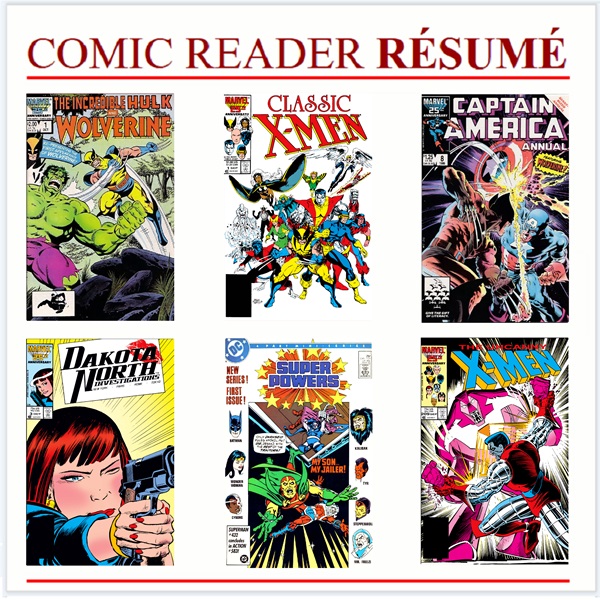
This episode includes Alpha Flight #38, Captain America #321 & Annual #8, Classic X-Men #1, Dakota North #3, G.I. Joe a Real American Hero #51, G.I. Joe Special Missions #1, Howard the Duck #33, The Incredible Hulk and Wolverine #1, Madballs #1, Marvel Age Annual #2, Marvel Saga #10, The Official Handbook of the Marvel Universe Deluxe Edition #10, Power Man and Iron Fist #125, Spectacular Spider-Man #118, Super Powers Vol. 3 #1, Uncanny X-Men #209, X-Factor #8, and more!

“Transcripts” Alpha Flight, Captain America, DC Comics, Dakota North, G.I. Joe, Howard the Duck, Incredible Hulk, Madballs, Marvel Comics, Masters of the Universe, Spider-Man, Super Powers, Wolverine, X-Factor, X-Men, Asteroid, Atari, Karate Kid, Movies, Music, Space Invaders, Superman, Video Games, Comic Reader Résumé

Saturday, June 1, 2024

Comic Reader Résumé: Late June, 1986

I'm only going to briefly mention Power Man and Iron Fist #125. I remember it making an appearance at the school playground around 1989. It was a friend's copy, and a bummer ending to the series. Danny Rand gets beaten to death in his sleep after using up all his chi to save a child, a lame supporting character is to blame, and he promptly disintegrates from an energy imbalance. This leaves Luke Cage to go on the run when he gets wrongly accused of the manslaughter. It felt like Jim Oswley was taking out his frustration at Jim Shooter cancelling the modest selling title to make room for the New Universe, when a better use of those energies would have been to just roll the creative team over to a New Universe title. That line could have used the help.

In a real "you had to be there" moment, there once was a hot ticket reprint title in Classic X-Men #1. 1986 is considered by many to be the greatest year in the history of comics publishing, and was undoubtedly part of the last period where comic books had a significant cultural imprint with record sales to match. Nothing was hotter for longer than the X-Men, and this title wisely eschewed the original X-Men stories to begin coverage of the poorly circulated, never previously reprinted All-New, All-Different era. Aside from a few Len Wein issues, this was the start of Chris Claremont's record run with Dave Cockrum, and the arrival of the most popular team member, including the joining of Wolverine. Byrne and Perez were still the biggest names in comics, but Arthur Adams was the hottest and most influential new talent-- the truest herald and originator of the hyper-detailed "Image style" that would dominate the next decade of comics. He offered one of the best and most character-packed mutant covers ever, plus a frontpiece. Copious additional pages were provided by John Bolton, who also drew the back cover, and would soon provide a well loved series of back-up stories to the title. At a time when back issues were much more difficult to locate, and trade collections were all but nonexistent, this was the best and most economical option for readers to finally catch up on the X-Men story from the beginning... of the new team that people actually cared about.

I may have already mentioned that my brother had a few Madballs, plus the first issue of the Star Comics series. If you didn't know, these were simply rubber balls with weird or gross faces sculpted on them. I remember their being hollow, so you probably couldn't properly bounce or bat them. How much catch can you play? You might not think that there was a lot of narrative mileage in floating spheres, and Star initially only gave it three issues. I guess they proved popular enough to be revived seven months later as an ongoing series that continued the numbering of the mini. Marvel maybe should have kept the money and ran, because whatever life the property had was spent by the tenth issue.

I was more suggestible in my youth, and hadn't checked in with DC Comics for a minute, so i think I succumbed to the "NEW SERIES! FIRST ISSUE!" hype on Super Powers #1. I still loved the toys, but was at a loss with regards to the newer characters from later lines. The likes of Cyclotron, Golden Pharaoh, Orion, and Tyr were mysteries to me, and I frankly think I was a sucker for the named floating heads bookending the cover image. The interiors by Paul Kupperberg and Carmine Infantino were really bad, perhaps crystalizing my lifelong anti-fandom for these two men. This comic fed into my general avoidance of classic Justice League comics for nearly another decade, and did no favors for the relatively minuscule Fourth World circles. Don't get me started on Darkseid's seemingly perishing from his own Omega beams, or that awful hood ornament Orion was wearing.

I've mentioned a number of times on the podcast that I watched a lot of private investigator shows as a kid, especially the female led ones like Remington Steel and Moonlighting. For whatever reason, I didn't gravitate toward the rumpled old Columbo types, or cops in general, but the glossier self-directed detectives for pay... or at least well-heeled dilettantes like Hart to Hart. So naturally a seeming femme fatale with full bangs wearing haut leather goods while brandishing an automatic with the single word "STYLE" brandished above her letterboxed upper torso should grab my eye. I didn't immediately get the joke in the name Dakota North, nor did I ever really "get" the book itself. I want to say it turned up during its brief and surprisingly sporadic run somewhere in my orbit, whether newsstand or bookstore. On the surface, it was the kind of book that I'd want, but then I'd flip through it and put it back. I want to say my brother had an issue at some point, and I believe I bought a discounted "scratched and dinged" copy at the comic store that I went to right before leaving for Nevada. I think, but am not certain, that issue was #3. The close-up of Dakota aiming her piece seems the most familiar of the covers, as does the splash of her intolerably smug younger brother Ricky touring the Eiffel Tower with a gal pal. I was old enough to see the appeal in the off-kilter cartooning of Tony Salmons, but I still gravitated more toward the flashy than the artsy, and Kyle Baker always had a stronger brew for this particular approach. If you have to choose between a collection of Dakota North or Why I Hate Saturn, you pick Saturn every time. To my knowledge, this series was Martha Thomases only writing credit, and I understand that she struggled with the violence required by the assignment. You would think that would mean the scripts would favor the characterization, but I couldn't get a feel for any of these people. It all seemed obtuse to me-- unsure and at odds with itself. So if anything, I favored the wild action and mild cheesecake where the art broke lose of the unengaging story. Like I said-- I tend to flip through issues when I come across them in dollar bins-- there's something there, but seemingly not enough for most audiences. I would encounter a better and earlier handling of this character type in Collins & Beatty's Ms. Tree, another Marauder Comics quarter pull.

Someone on social media recently tagged me on the announcement of a crowdsourced compendium of the Marvel G.I. Joe comics that was funded in six minutes and had over a million dollars in the kitty at last count. The other person tagged was Ryan Daly, who has often appeared on , if not outright co-hosted, Joe podcasts. He collects Joe stuff and is keeping up with the modern Skybound Energon Universe stuff, like seemingly everybody else. That made sense. It was the me part that I didn't get. I haven't read a Joe comic since the Devil's Due run first started, and while I retain some mild nostalgia, my fandom feels like it happened in another lifetime. But then I remembered this podcast, which has consistently featured Joe content. I talk about Secret Wars being the first series that I collected every month from when I started with #3 until its end, or how Dreadstar & Company was the first book I had a complete set of. Or how I followed Uncanny X-Men to some degree for over a decade from January of '83, and what a formative series that was for me as a person. But before that, I bought action figures, especially G.I. Joes, and I've been talking about the animated commercials and TV series, and buying the comic more months than not from #11, and here we are at #51, plus Yearbooks and now we're launching a spin-off series. As much as I feel this book is in my rearview mirror, especially the rah-rah Real American Hero politics, the paper trail surely indicates that I was a much more devoted fan of this franchise than any other in my earliest years of collecting.

And so we come to G.I. Joe Special Missions #1, previewed in #50, adorned with a dynamic Mike Zeck cover, spotlighting... um... I dunno. Snake-Eyes is in the background, one of two Joes scaling the side of a ship while firing Uzis. They're both in modified scuba gear, so from the colors and flat top I guess Duke? But his hair's more orange than blonde, and he just doesn't "read" as Duke, especially since a more iconic Duke figure is in the corner box for comparison. Neither is in the actual comic, which is a sea adventure mostly involving The Baroness. The art didn't exactly blow me away, and my memory is of seeing it in a three-pack at a K-Mart that I did not pick up. I don't recall if I'd passed on it at the newsstand, probably not helped by it's continuing into the next issue, or if I decided against the book interiors unseen at the department store. What I can say is that this was maybe the first chink in the armor of my Joe collecting period, and it seems given the choice, I got an X-Men pack instead.

My experience of Howard the Duck up to this point was mostly in passing. He'd been a big fad in the 1970s, especially during his Pat Paulsen-aping mock presidential run. There were plenty of period Marvel house ads for subscriptions; the magazine; the Treasury Edition. But in terms of actual comics read, it was just the second issue at my uncle's friend's house with the inset bookshelves from which I modeled my own current and long desired set-up. And to be honest, that's still going to be it, because I fished the weird, years-belated Howard the Duck #32 & 33 out of the Marauder Comics quarter bin in 1989. Instead of being decent human beings about it, the final issue of the original run came nearly a year after the previous one, and that was over six years after the real finale from 1979. Worse, it teamed Howard co-creator Val Mayerik with some unknown, rather than offer Steve Gerber the work. It was a one-off, rags to riches to rags story to meekly support the upcoming movie, distinguished only by tardiness and admittedly one of the best ever Howard covers by Brian Bolland. That'll do, duck. That'll do.

The Incredible Hulk and Wolverine #1 was another one of those weird newsstand outliers that cost a whopping $2.00 and was extra length on sturdier (but non-Baxter?) stock. It had a new wraparound cover by John Byrne, but the interiors were all reprints. Mainly, it was the two-part introduction of Wolverine by Len Wein and Herb Trimpe from 1974's Incredible Hulk #180-181. Also, and much rarer, there was a new 6-page Hercules/Wolverine story from 1980's Marvel Treasury Edition #26 by Mary Jo Duffy, Ken Landgraf, and most importantly, inked by George Pérez. Nowadays, all three of these stories have been reprinted many times over, including a full reprint of this edition in a squarebound version with a new Trimpe cover in '89. However, in 1986, this was the first time these stories had ever been made available again, much less in a relatively affordable upscale format on the newsstand. While it may not have been held in the same esteem as Phoenix: The Untold Story, I still prized this edition, especially the pages of back matter detailing the origins of the character, as created by Wein and artist John Romita Senior, including the design sketches. This may have been the first time I heard about Wolverine's distinctive mask flaps coming out of Gil Kane having screwed up on a cover, with the interiors made to match. I was somewhere near my peak Wolverine fandom, and aside from Marvel Age and the rare trade paperback, there wasn't a lot of opportunities to get that kind of education on the creative process.

Speaking of Marvel Age, our last stop this month is its second annual. The cover was a massive group shot of the main stars of the universe by Frenz and Sinnott, which was by necessity more crowded as a single page than Kerry Gammill's wraparound from the previous year. Starting with a reprint of a 3-page 1967 Lee/Kirby humor strip about themselves, we next got a highlight reel from Marvel's first quarter-century. Back then, "Marvel Comics" started in 1961 with the debut of the Fantastic Four, creating the illusion that a flush Baby Boomer could own every single Marvel Comic, and treating their wartime super-heroes from the series actually titled Marvel Comics as an out-of-continuity prototype. Next was Marvel A to Z, which was their own version of the Amazing Heroes Preview Specials, where they would give a few paragraph breakdown of each Marvel title's general course over the next half-year or so. Where the previous year, they'd blown a fat wad on 25 pages of original continuity storytelling, Marvel was tightening their belts to look more attractive for an upcoming sale. This time they only sprung for about 13 story pages to break up the text, plus some pin-ups with captions and dialogue balloons. The artists were generally lesser known than the 1985 crew, but Art Adams did a story page, and Walt Simonson a pin-up spread. Could you imagine a publisher paying for anything like this today? Anyway, either the New Universe titles weren't ready or, more likely, it was damage control for how lame they were coming out, but the only art for the upcoming line was one of Cynthia Martin's cosmic house ads of fuchsia lightning striking the Earth from outer space. It was still overall a nifty package, with a faux 1961 Marvel Age back cover by Richard Howell, but I still read my brother's copy.

Sunday, May 26, 2024

Comic Reader Résumé: Early June, 1986

I didn't realize how off my May comics reading was until I came back for June, and all the books that double-shipped in April that were then absent a month. I'm pretty sure that my brother came back for Alpha Flight #38, the last part of the one with the zombie ghost pirate with the pestilence and all the Shadow of the Hawk shamen and the Canadian kaiju and whatever. Bill Mantlo was doing some cool weird horror stuff in here, and I especially like when Snowbird goes full Sasquatch primal rage and each swipe of their claws makes the pirate go Benjamin Button. I like to think that in 100,000 years, the sentient upright cockroaches will read that paragraph and it will become one of their great archeological mysteries. But also, the book failed me as a kid, because it was both too weird and not weird enough. There's a whole B-plot with Namor and Marina involved in an Atlantean military conflict that was just-- yawn. Dave Ross' art is straight super-hero, but it's being compromised by Gerry Talaocs inks, which recalls but never reaches the heights of the great '70s Filipino horror tradition from guys like Alcala and DeZuniga. The ingredients aren't gelling, and whole approach feels like a half-measure.

Mike Zeck had a whole run on Captain America that was awesome inside & out, then became one of Marvel's top cover artists, including a return to Cap for many iconic frontpieces. With so many iconic images from this time period coming from Zeck, it's easy to forget his work on Captain America #321. When J.M. DeMatteis rage quit the book over the editor-in-chief retroactively cancelling an already approved new direction for the book, and Jim Shooter adding insult to injury by rewriting chunks of his last issue, Cap had something of a lost year. Editor Mark Gruenwald eventually took over as writer, but he was never a marquee name, and his artists weren't going to bring any heat to the book. I think Gruenwald made the conscious decision to court controversy, through heated political content, shocking large scale deaths, and so forth, to bring attention to the title. The United States was re-embracing militant jingoism, reflected in Mike Zeck's moving on to the scorching hot Punisher mini-series, and a long memorable run of G.I. Joe covers. I think Gruenwald wanted to trap some of that heat with this month's image of a howling mad Star-Spangled Avenger firing an uzi. It was a provocative image that grabbed eyeballs, and started a dialogue that has been lost to time, as it's memory was buried by other bold moves. But at the time, it was such a hot ticket that I couldn't find a copy of my own, and had to glom what I could about what happened from those peripheral conversations.

Given how much I was waxing Mike Zeck's car, you'd think I'd be more excited to cover Captain America Annual #8. Everyone knows the cover of Cap's shield being raked by Wolverine's claws, and I've lost track of how many times it's been swiped. But we don't talk much about the interiors, which are... fine. There's a lot of Logan at the front of this story, and you can see that's where Zeck spends most of his time and interest. It wouldn't shock me if he'd requested to draw the fan favorite character, but he's also competing with recent work on the Canuck by John Byrne, Art Adams, Paul Smith, Frank Miller, Barry Smith... even John Romita Jr. had a quite iconic Wolverine cover a couple months prior. Zeck drew Logan's hair weirdly plastic-- more like Deathbird's feathers, and he skimped a bit on the body hair. It's still good, but in that company, doesn't really stand out. Then the issue drags on, with Wolverine and Captain America in parallel investigations of a giant robot, and you can tell inker John Beatty is picking up more and more of the slack. We're dozens of pages in before the heroes finally meet, and their fight spans one half of two pages before they team up against the robot. After a few pages of tussle, the robot escapes, and they... split back up again? So then there's more of the detective work that fans of these two characters crave, followed by another team-up, where the main use for Wolverine's claws is to act as a lever so that Cap can wack his hands with his shield to wedge off the robot's adamantium head. Finally, three pages of the heroes... chasing the guy operating the suit? By this point, you can't even tell who's drawing the issue if you take the pages out of context. This tale is such a damp squib after that firecracker cover. A real waste of characters, time, and talent on a book that really needed a back-up feature instead of an exhausting length.

I wasn't too thrilled with G.I. Joe a Real American Hero #51, an action-heavy issue with a John Byrne cover involving Sgt. Slaughter and the Dreadnoks. I probably just tossed through lil' bro's copy. Same went for The Incredible Hulk #323, which was mostly a lot of babbling in the aftermath of the battle with the Avengers. There was a metatext about Bruce Banner fading into immateriality with his connection to the Hulk, so Vision facilitated their re-bonding. Marvel Tales shook me loose entirely this month, jumping from reprinting the early John Romita run to a triple-sized, double-priced collection of stories preceeding the deaths of Gwen Stacy and Green Goblin. I don't know what precipitated the change, and it would only last another issue before switching format to something I'd find more palatable.

The Marvel Saga, the Official History of the Marvel Universe #10 is a big one, as the Keith Pollard cover announces the debuts of the X-Men and the Avengers. The origin of Doctor Strange is not so heralded, despite taking up much of the first ten-plus pages. After some capsules, we get a lot of Namor's Atlanteans attacking New York and Dr. Curt Conners becoming The Lizard. The origins of Beast and Marvel Girl are bound up with the X-Men debut.

The Official Handbook of the Marvel Universe Deluxe Edition #10 falls a bit behind the times by relegating a squatting Punisher to the back cover in favor of... Rachael Summers, Puck, and Power Man? Ouch. "Paladin to The Rhino" starts with a Brian Bolland Paladin, of all combinations. He does freakin' Purple Man in here, too. Stan Woch's Plantman is offensively cool. Like, how dare you waste the effort it took to make this mort look like a menace? He must have lost a bet or something. Just... why? David Ross offers an oddly moody Puck, but this was mostly a solid if unexceptional issue. I really liked John Buscema's Red Wolf, though.

I think maybe there was a gap in seeing my brother, because I passed on enough issues of Uncanny X-Men that I felt compelled to buy #209. The battle between Nimrod and the Hellfire Club was too good to resist, especially with multiple fatcat white guys dying.

I was never wild about Bob McLeod finishes, so even with Mike Zeck joining Peter David on The All-New, All-Daring Peter Parker, the Spectacular Spider-Man #118, I just passively gave my brother's copy a toss. It was the resolution of the subplot about the kid who accidentally vaporized his abusive father with energy powers, and turned into a S.H.I.E.L.D. free-for-all wheere the kid gets gunned down.

X-Factor #8 had breakdowns by Marc Silvestri, and he was good at drawing Mystique and her Freedom Force. I like Jackson Guice, but by this point he was so associated with these awful early issues, it's nice to start putting daylight between the Layton & Simonson runs.

Sunday, May 19, 2024

JLApe: Gorilla Warfare (1999)

In Legends of the DC Universe #19 (August, 1999,) the arrogant and generally disagreeable "Gordon Matthews" infiltrated Manchester Junior High School in Alabama to act as a rival to Bart Allen. Meanwhile, Max Mercury investigated the theft of four gorillas from the Manchester Monkey Business School, which trains simians for show business. Max discovered three of the apes raising an international ruckus while wearing helmets that siphoned from the Speed Force. The fourth gorilla was in the custody of "Gordon Matthews," who revealed himself to Impulse as Gorbul Mammit, the son of Gorilla Grodd, looking to continue his legacy feud with the Flash Family. Having kidnapped Bart's young friend Carol Bucklen, he intended to transfer her mind into the "seductive body" of the fourth gorilla, to make her intelligent enough to serve as his bride, but Impulse foiled the scheme. Grodd was amused, but felt that the boy was thinking too small. A cute story by Jason Hernandez-Rosenblatt, Pop Mhan, & Romeo Tanghal.

Elsewhere, relations between Gorilla City and the human world heated up and cooled down inside a week, with the assassination of Solovar and the rise of the Simian Scartlet that launched hostilities against the United Nations in JLA Annual #3. Then gorilla agents assailed Bludhaven and Atlantis in Batman Annual #23 & Aquaman Annual #5. As explained by Martian Manhunter in his second annual, "Led by simian sorceress Abu-Gita, apes invade the island nation of Themyscira." [Wonder Woman Annual #8]

"In Central City, the Flash, Max Mercury, and Impulse are enslaved by the long-time outlaw called Gorilla Grodd-- to charge his Speed Force reactor, providing the morphic resonator array with a power source to substitute for The Eye of Poseidon." J'Onn isn't usually a sexist, but he missed listing Jesse Quick. Walter West, an older version of Wally from a darker timeline, had lost his battle for self-control after being turned into "Flashorilla." Despite having four super-speedsters on the scene, none were fast enough to avoid getting turned into gorillas themselves. They were then put on treadmills to power another attempt to further spread the ape-conversion process. "Chimpulse" actually started to figure out that he'd been duped into Grodd's service, but then got distracted by unlimited access to bananas. More typically, Chimpulse got distracted from the distraction, and needing stimulus beyond running in place, returned to philosophy. His questioning of Grodd's plan played poorly with the pleebs, but won over the speed-apes. Further, while evading capture, Impulse vibrated through a wall and reverted to human. It was deduced that the Speed Force assists in reforming speedsters under this type of circumstance, and reset their matrix to its default. The speedsters then dismantled Grodd's apparatus, but the super-gorilla himself evaded capture. "The Apes of Wrath" was by by Brian Augustyn, Doug Braithwaite, and Robin Riggs. The Flash Annual #2 (October, 1999) was a cute story that the artists did their best to play for laughs, but their basic style is still too seriously inclined for the material. It just creates a Roger Rabbit effect of mashing cartoons against real world humans that don't quite match up.

Martian Manhunter continued, "In Washington, the smuggled components of the gorilla-built war machine dubbed 'Grogamesh' are assembled. Piloted by Ulgo, Grogamesh kidnaps Daily Planet reporter Lois Lane, and is defeated by Superman." Despite being played for villainy in early episodes, Ulgo had a legitimate urge to avenge his slain uncle, which was exploited by Abu-Gita, who concealed the more sordid aspects of her magical incantations. In Metropolis, the Monk of Steel was failing to control his feral inclinations, but was swayed by encountering his wife. Her first suggestion to find the scientist Emil Hamilton didn't pan out, as he had gone full ape, so Supermonkey decided to "kill or cure" by flying near to the sun. There was a fake-out when he appeared to grow to Titano proportions, but he had in fact reverted to Kryptonian, and the giant was the fur-covered Grogamesh. In battle, that was burned away, revealing the metal bohemoth beneath the facade. In fact, those pelts were key to resolving said battle, as they were made from the skins of a thousand sacrificed apes, as part of Abu-Gita's plot to more literally invoke the heroic legend of Grogamesh. As a modern moderate, Ulgo was disgusted by this betrayal of his principles, and began to understand that he had been misled. Oh, and Young Justice turned up too late with a giant exploding banana, just in case. Against the odds, Superman Annual #11 (October, 1999) managed to immediately recycle the pun title "The Apes of Wrath," this time by Abnett & Lanning, and Joe Phillips with Faber & Stull. Phillips already trends toward a cartoonish art style, so here he simply had to lean into it. It helps land a few good bits, like a variation on the "it's a plane" dialogue, exclusively in grunts.

The Gorilla incarnation of Kyle Rayner was unable to restore himself to humanity on his own, so he was assisted by J'Onn J'Onzz in Green Lantern Annual #8 (October, 1999). "Thanks to my rather duplicitous efforts, Green Lantern was restored to normal, as has been the rest of the JLA." In fact, the entire episode of Gorilla Warfare was then resolved in Martian Manhunter Annual #2 (October, 1999)...

Sunday, May 5, 2024

DC Special Podcast: Another Hour with Julia Raul

To permanently save this episode’s MP3 file to your computer or other listening devices, right-click the link below to bring up sub-menu and select “Save Target/Link As…” Pick where you want it to save to, and you’re set.

Download MP3

Rolled Spine Podcasts are on Spotify, iTunes, and the Internet Archive.

Coarse Language: Listener Discretion is Advised

Meanwhile... A roaming b-roll conversation with special guest Julia Raul. JLA artists, '90s super-hero cartoons, Hitman, Azrael, Bane, Deadpool, Maxima, Steve Ditko, queer representation in characters, mixing DC with Wildstorm, and far more tangents than can be summarized here...

We Think You're Special! Animation, DC Comics, DC Special, DC Special Podcast, Wildstorm

Tuesday, April 30, 2024

Comic Reader Résumé Podcast #22

(May 1986)


Internet ArchiveMP3Spotify

ré·su·mé [rez-oo-mey, rez-oo-mey] noun 1. a summing up; summary. 2. a brief written account of personal, educational, and professional qualifications and experience, as that prepared by an applicant for a job.
In Comic Reader Résumé, I use Mike’s Amazing World of Comics to travel back through time via his virtual newsstand to the genesis point of my lifelong collecting of comics. From there, I can offer a “work history” of my fandom through my active purchasing of (relatively) new comic books beginning in January of 1982, when my interest in the medium went from sporadic and unformed to routine on through compulsive accumulation. To streamline the narrative and keep the subjects at least remotely contemporaneous, I will not generally be discussing what we call back issues: books bought long after their publication date. Sometimes, I will cover a book published on a given month that I picked up within a year or so that date, and I give myself an especially wide berth on this aspect in the first couple of “origins” episodes. We’ll get more rigidly on point as my memories crystallize and my “hobby” spirals out of control into the defining characteristic of my life (eventually outpacing squalor and competing neuroses.) It’s part personal biography, part industry history, and admittedly totally self-indulgent on my part.

This episode includes Elvira's House of Mystery #6, Fantastic Four #293, G.I. Joe a Real American Hero #50, Marvel Age #41, Marvel Saga: the Official History of the Marvel Universe #9, Masters of the Universe #3, Son of Ambush Bug #2-3, Spectacular Spider-Man #117, The Mighty Thor #370, Uncanny X-Men #208, Web of Spider-Man #18, West Coast Avengers #12, X-Factor #7, and more!

“Transcripts” Ambush Bug, Avengers, DC Comics, Elvira, Fantastic Four, G.I. Joe, He-Man, House of Mystery, Marvel Comics, Masters of the Universe, Spider-Man, Superman, Thor, X-Factor, X-Men, Comic Reader Résumé

Sunday, April 28, 2024

Comic Reader Résumé: Late May, 1986

As I've probably mentioned in the past, but just to recap, I manage to evade John Byrne's Fantastic Four better than most in my generation. I remember seeing the Diablo cover with the FF as candlesticks and thinking that looked cool. I think I tossed through the triple-sized 20th anniversary issue. I believe the sideways issue was at a barber shop that I went to, and the same may have been true of The Masque of Doom photo cover. I of course got the She-Hulk papped topless issue, and one of the "Dark Sue" Malice issues. Ultimately though, I preferred She-Hulk as an Avenger, and I bought more Thing solo comics than FF ones up to this point. I think I got Fantastic Four #293 out of a 3-pack with something else I wanted more, but at least it was another She-Hulk cover. Her, I liked. The Storm-Richards Family, never. Reed was like a pedantic high school science teacher, Sue like a wallpaper Kindergarten teacher, and Johnny felt like a pretty boy bully somewhere in between. I was so invested in the Fantastic Four that I struggled to figure out how it related to the movie Fantastic Voyage. The shrinking one with Raquel Welch, not the Sinbad one. I was ignorant, not an imbecile. The 1967 Hanna-Barbara cartoon ran really early in the morning, and the 1978 one with H.E.R.B.I.E. was too lame and short lived to rate much attention from me. As you've probably noticed, I was quite the Marvel Zombie at this point, and the FF felt like a DC team in the most pejorative sense. You had the one crazy kid in the padded cell screaming that he was Dr. Doom, and then most of the issue was doing science stuff in the desert to a big ink blob. Toward the end, the team get sucked into some future state where the original FF were worshiped as gods, which felt very Mort Weisinger before I knew what that meant.

Thor was another one of those old-timey Kirby-type books that did not appeal to me. I tossed through the one with Dracula as a back issue. The Walt Simonson stuff had a great sense of power to it, and I did eye that first Beta Ray Bill cover and his continuing adventures, the frog stuff, and that one killer spread from a Marvel Age annual where the Asgardians were using conventional assault weapons. Nothing ever sealed the deal though, and quite randomly, I dipped in on a fill-in. I don't recall if I bought The Mighty Thor #370 on purpose or out of three-pack, quite probably the same one as the Fantastic Four. I wonder what the third book would have been-- maybe an Uncanny X-Men? Anyway, it had a nice inventory pin-up cover by Big John Buscema, but the interiors were inked by P. Craig Russell, for a very contrasting look. Both Thor and FF had gorgeous John Workman lettering, which couldn't have hurt. The story was a western titled "Easy Money," and was written by Jim Owsley, the future Christopher Priest. It was about a wannabe Bat Lash style card sharp who has a run-in with a Lee Van Cleef type with a band of murderous outlaws planning a train robbery. If you say that sounds like a typical Thor story, that's exactly why I liked it, as it had a bit of a Highlander vibe, but in the Weird West. To say more would spoil it, but despite spending years in obscurity, it seems to have reappraised and lauded over the years, recently added as a bonus story in the final Black Panther by Christopher Priest Omnibus that sits on my bookshelf.

I'm pretty sure that my brother bought The All New, All Daring Peter Parker, The Spectacular Spider-Man 117. The cover featuring Black Cat battling Dr. Strange is very familiar. It was another "Missing in Action" tie-in with a blink & you'll miss it Sabretooth cameo. Also, the last page with a woman drinking coffee in the mountains near Spidey's shredded costume, unquestionably by a different art team than the main story, is a solid memory for me. However, the actual story by Rich Buckler and a young Dwayne Turner, wherein they give Black Cat her equivalent of Dinah Lance's jazzercise outfit, drains all the energy out of me just by looking at it. I never read this thing.

Weirdly, Louise Jones is credited as writing X-Factor #7, even though she was Simonson last issue and Walt will be penciling the title in a few months. I bring this up mostly because the actual issue offers nothing of interest. This is the one with the big bald guy and the slug guy. Also, this was during that period where the team wore uniforms and pretended to be Ghostbusters but mutants, while also wearing their X-Factor costumes and supporting mutants. But both these groups have five members with distinct body types, only one girl who's a redhead on both teams, and one guy who wears red glasses per team. Who fell for this?

I don't recall if I ever bought the two-issue, double-length Lois Lane mini-series by Mindy Newell and Gray Morrow. I just know that it haunted the quarter bin at Marauder Books in 1989, and that wasn't the only shop I could say that about. Even if I did finally pick it up to own, I've yet to read it. And hey, while I'm shouting out Marauder's clearance bins, let me also mention other frequent detritus like Independent Comics' The Epsilon Wave, Mr. Monster's Hi-Octane Horror #2, Nervous Rex, various issues of Eclipse's New Wave, Blackthorne's Pre-Teen Dirty-Gene Kung-Fu Kangaroos #1, Elite's SeaDragon, Aircel's Stark Future #1, and Ocean Comics' Street Fighter. I often use the Champions RPG as a shorthand for uninspired, plainly derivative, fannish junk characters in pedestrian stories by anonymous journeymen and never-wases. This is in part because I fished Eclipse's adaptation, Champions #1, out of these bins, and it was the platonic ideal of basicness. It made the New Universe look like Watchmen by comparison.

Lil' bro might have had a copy of Star Comics' Masters of the Universe #3. He definitely had figures of Orko, Battlecat, Prince Adam, and probably the cover-featured Slime Pit. He was a prolific collector, who owned most of the 1985 and 1986 figures. Just at a glance, I recognize Moss Man (a repurposed Beast Man,) Roboto with the transparent chest that let you see his gears, Sy-Klone, Two Bad with two heads and a pair of action-swinging arms, Stinkor, Spikor, Leech with the suction cups, Mantenna with the bug-out eye-stalks, Modulok with two heads and six insect legs, Extendar with techno-expanding neck and appendages, Rio Blast-- who looked like a redneck crossover with the C.O.P.S. line, King Hiss-- who was made out of snakes inside a removable human suit, and some of the stupid Transformer guys that turned into rocks. He also had a number of vehicles, but I didn't care as much about those. Battle Bones sticks out though, because it was a dinosaur skeleton with hooped ribs that doubled as a carrier for a bunch of figures. We both had color variations on Hordak and Grizzlor, mine with the lighter brown fur and his near-black. The Horde Trooper was featured in this comic, and at first I though he had one, but now that I look, I'm not so sure. All this is to say that the comic looked like kids' stuff, so I skipped reading it.

If there's one thing I'd rather not have to write up in one month, it's Son of Ambush Bug, and yet here we're back for more or less a third helping. I do have angles though. DC Comics fans talk a lot about the impact of Crisis on Infinite Earths, and particulars like how Roy Thomas got hosed by losing access the Golden Age heroes amidst the obliteration of Earth-2 from continuity. But what about Julius Schwartz?

After Mort Weisinger lost his editorship over Superman, his life spiraled, and he was destitute when he died. Nothing so dramatic happened with Julie, but after line of DC Science Fiction Graphic Novels adaptations floundered in 1985, and with the massive editorial overhauls of 1986, Schwartz was more or less shown the door. He would continue as a sort of goodwill ambassador for DC Comics along the lines of Stan Lee, with some sort of stipend involved, but as a powerful figure, the man was done. And in this very issue of Ambush Bug was an ad for the Man of Steel mini-series, with Andrew Helfer as the new overseer of the Superman line, and John Byrne the primary creative force who was intentionally erasing much of the body of work Schwartz had commissioned for that character since the 1960s. It's hard not to see the largely plotless excesses of Son of Ambush Bug as a sort of primal scream of rage and quiet whimper of futility at the injustice of its creative team's straits. Everyone involved was losing "their" DC, and probably their financial welfare, and also having their memories and legacies scrubbed before their eyes.

The book goes to dark places, as when a secret government operation tries to use the Ambush Bug suits left on his many corpses to develop agents who could teleport, only to learn the suits were literally devouring their wearers. Or how the tossed-off gag of an Ambush bug-fronted super-team from the first mini-series was now seeing its underdeveloped membership committing suicide. And that's before they die a terrible running gag about iguanas into the bombing of Hiroshima. But again, I found this madness engrossing, trying to figure out mysteries about what I'd miss that were never meant to even be considered, much less solved. In retrospect, everyone was just filling pages, and there's a genuine underlying anger to the anti-humor.

I've heard that Giffen would often just draw random things and hand off the pages to scripter Robert Loren Fleming to figure out what to do with, not offering any notes or suggestions. I tend to think that's why this mini-series is amused with itself, but not actually directing any sincere humor toward an audience. It's all a hostile meta in-joke, with the embodiment of capricious editorial feat in the cosmic villain The Interferer turning the creatives into his whipping boys. And yet, I adored the art, the constant breaking of the fourth wall, the jokes lobbed by and against the various named members of the creative team. Schwartz is clearly absentee, but he gets his turn. For instance, the issue is sandwiched between splash pages of a barely clothed airhead bimbo who hosts the comic, and in the end is left in the clutches of Schwartz, which reads a lot different after Colleen Doran's accusations that Schwartz was a sex pest. I have no doubt that Giffen's jab at Jules were affectionate, but even here, there's a grim undercurrent.

Web of Spider-Man #18 was I think the last part of "Missing in Action," and it was about how anyone who thought that scraps of Spidey's costume lying around after a battle meant that he was dead was a dummy. Like, Web-Head pioneered torn costumes. So he was running around, beat up and half naked, doing a reenactment of a Macon County Line or Born Innocent or one of those other movies where regular folk are railroaded into prison by crooked southern authorities. Anyway, Peter eventually got loose and hitchhiked home. There's also a teaser for the arrival of Venom. This was another of my bro's books. Easily the most interesting thing was Kyle Baker inking Marc Silvestri.

West Coast Avengers #12 was I think another bro-chase, which I recall mostly for the debut of Wonder Man's red & green costume, which I still thinking is among the most hideous suits ever worn by a mainstream hero. I think JLGL drew it for OHOTMU, and if he couldn't salvage it, nobody could. Speaking of OHOTMU, there's a trio of new villains introduced, and ZZZAX with three z's will perpetually be thed last entry in future volumes. Quantum was trying to compete with Wonder Man's couture, so the only one to catch my eye was Halflife, a blue-skinned zombie hooker almost certainly inspired by Linnea Quigley's character from Return of the Living Dead. The final splash featured Graviton, who I took to be a low rent Magneto, and have yet to be disabused of that notion in 38 years. The blue & white suit looks good, though.