Showing posts with label Plastic Man. Show all posts

Tuesday, March 8, 2016

DC Special Podcast: Berlanti Television (2016)


Coarse Language: Listener Discretion is Advised


Look for us on iTunes & ShoutEngine or directly download an art-tagged MP3 from the Internet Archive


Meanwhile... Mr. Fixit & Diabolu Frank welcome back the uncensored cuss words favored by Rolled Spine Podcast listeners as they discuss the "Berlantiverse" of DC television adaptations The Flash, Supergirl, Arrow and DC's Legends of Tomorrow. It's an ADHD ramble though, so the conversation jumps around to the announcement of #Rebirth, Alan Moore's legacy at the company, Jack Cole's Plastic Man, Snyder & Capullo Batman, the Dark Knight Returns sequels, Roy Harper Lee, Forever Evil, the DTV animated movie Batman: Assault on Arkham, and in a real tangent, Deadpool, Agents of S.H.I.E.L.D. and the showdown between the Marvel Cinematic Universe, the FoXCU and the DC Extended Universe.

We Think You're Special!

Sunday, January 26, 2014

2012 Strong Suits: Superhero Playing Cards Plastic Man art by Craig Bostick

Click To Enlarge


"I’m working on a personal project, illustrating a deck of playing cards using characters found in DC comics between 1957-1967 — the height of the kitschy Silver Age of comics. I’ll be posting one illustration every weekday for 11 weeks, which will take us just about until the end of May. 55 posts = 52 regular cards, 2 jokers, and the design for the back of the cards. It’s an ambitious project for sure and I welcome any feedback and constructive criticism."
Craig Bostick

Tuesday, November 19, 2013

Justice #12 (August, 2007)


Superman whined to himself about how he wished someone else was Superman, and how he's responsible for what happens to every bullet that bounces off his chest, and oh do cry us a river Man of Steel. No wonder so many people find you unsympathetic. Superman did this while smashing up the Toyman's city of malevolent playthings as the script writer caption box monologued like a low rent Alan Moore just as hard as he could, bless his heart. The physical Toyman was found to be a shirtless unkempt chubby geek overrun with Brainiac's nanotech who was obsessed with saving the children of the world in a vaguely pedo way, which is about as insightful as pointing out that wool is itchy, but the junior college will cash your Creative Writing 101 tuition check all the same. Finally, Toyman revealed how many nuclear warheads Brainiac had taken control of: "All of them." So money! So, so money!


Superman then flew to Scarecrow's city, where Green Lantern Hal Jordan handled citizens driven mad with fear. Yes fear. Will, against fear. Got it? This prompted Scarecrow to run away into a sewer... where the Joker happened to be lurking... dressed as Bela Lugosi's Dracula... and proceeded to bite his "Super Friend" on the neck for leaving him out of the Legion of Doom. META TEXT! Joker needs plastic fangs! META TEXT! Joker needs plastic fangs! META TEXT! Joker needs plastic fangs! META TEXT! Joker needs plastic fangs!


The Marvel Family flew the innocents out of Toyman's city atop a giant, er, top. Stretching men Plastic and Elongated were also essential for evacuations elsewhere. Most of the characters featured in the mini-series remained visible doing obligatory background stuff like that without contributing to the primary narrative. Lex Luthor was the main person responsible for finally corralling Brainiac, while others halted the doomsday missiles he'd launched. Zatanna was key to getting Superman to Brainiac over and over again, who was captured almost as an afterthought, and its not like his plan hadn't already been foiled. Basically, Superman was only around to rescue Zee after she was imperiled by the final leg of the pursuit. Later, the Man of Steel gave a frozen, miniaturized Brainiac to the Kandorian Museum. Batman-- get this-- Batman insinuates that this very capital-I IMPORTANT vanity project adventure might have been the first step toward lasting world peace, and it's insinuated that it leads to the utopic future of the Legion of Super-Heroes, including a gratuitous two-page spread.


The extra long, extra torturous final "Chapter Twelve" was plotted and painted by Alex Ross. The script was provided by Jim Krueger, and the penciled layouts by Doug Braithwaite. None of these men have any share or even self-awareness.

Continue the story through these character-specific posts:

Thursday, October 24, 2013

Justice #11 (June, 2007)


Hal Jordan waxed philosophical about his foe Sinestro while providing narration for this issue. "Thanks to Sinestro, I was given a taste of what it would be like to rule everything. Thanks to my enemy, I will now never become anything like him... I don't need to be the greatest anything anymore. I just want to help my friends. And my world." I'm not sure if that was meant as a rebuttal against "Emerald Twilight" or if it reinforced it. All in all, it would really only take another random blow to the head to send Hal off in any given direction anyway.

The big siege progressed. Metallo tore apart Platinum while the Man of Lead continued fighting Black Adam. Parasite decided that he needed to "end this," so he grabbed Adam's foot to steal his powers, then swiped the kryptonite heart out of Metallo. Bizarro was grappling with the Man of Lead, affording Parasite the opportunity to rip through "Superman's suit" to discover Lead had actually helped to conceal Captain Marvel. The power of Shazam slammed Bizarro into Parasite, then the Big Red Cheese gave Hal Jordan the order. Iron's armor over Jordan had concealed the fact that Hal was wielding Sinestro's lost spare yellow power ring (that had been lent to Grodd but stolen by Metamorpho) through a filter of blue kryptonite. The blue K immediately took out Bizarro, while Captain Marvel crushed the piece of green K Metallo thrived on.


Ross had fixed the incorrect Platinum symbol on Plastic Man's armor to shift it to Tin, but it was never explained how Gold could pretend to be Green Arrow and cover Superman at the same time. Anyway, the shiny gold mummy quasi-Shazam Superman was attacked by the Parasite. Black Adam thought Captain Marvel liked seeing him weakened, but Billy was too innocent to enjoy another's suffering, though he was willing to choke Adam until he said the magic word. The ensuing lightning bolt conveniently struck Parasite on its way to removing Adam's powers. Plastic Man contained the Riddler in his fleshy mass while Tin (absent his familiar stutter) separated to cage Parasite. It seemed from his demonstrated pomposity that Ross and company had confused Tin with Mercury, who the Flash was still wearing, at least until he was used to gag Teth-Adam.

Green Arrow had delivered Hal Jordan's power ring to John Stewart, who by the spoken narrative grace of Jordan had been allowed access to Hal's incredible power as Green Lantern to free the teenage super-heroes from the control of Brainiac's nanotechnological worms. The same tech briefly retook the Leaguers made vulnerable by their release from the Metal Men "armor," but John Stewart promptly liberated them. Hal Jordan is so awesome for allowing his Negro acquaintance to save the day (but not allowing him any lines of his own, heaven forbidding such impropriety.)


Yellow Lantern Hal Jordan continued to match Sinestro with the same type of power ring, openly acknowledging that should he falter, John Stewart and the Justice League would surely avenge him. In response, Sinestro offered the scintillating bon mot "Shut up. Shut Up. Shut-the-hell-up!" Does Korugar even have a concept of Hell? When in doubt while writing Green Lantern dialogue, always try to hear Nathan Fillion saying Hal lines and Vincent Price saying Sinestro ones. Jordan and Sinestro tapped out their power source and switched up to mano-a-mano. Jordan beat Sinestro bloody, claiming that it was not vengeance he sought, but justice. Then both men fell through the top of a black city-sphere, and John Stewart apparently laughed off-panel as he returned Jordan's power ring so he could save himself and Sinestro.

The villains present on the main scene were either shut down by force or through the disabling of Brainiac's influence. That left the previously hostage supporting casts to mingle with their heroes, or in John Stewart's case, to get stuck with Tom "Pieface" Kalmaku, Carol Ferris, and Hal's brothers. The Flash and Iris West had a sweet if inhibited WASP pseudo-embrace, while Superman and Lois Lane had a big ol' sloppy wet P.D.A. Supergirl looked on from a distance as Lana Lang and Jimmy Olsen milled about. Captain Marvel was oddly separated from Mary and Junior, preferring Zatanna's company (though who wouldn't?) Rita Farr held Robotman's brutally battered severed head.


The Super Friends followed Brainiac to Toyman's world, where Superman took the fight deep into the heart while everyone else tore apart duplicates of Brainiac in a somehow self-serious spread. Zatanna then teleported everyone but Superman to Scarecrow's creepy 19th century European faux city, though Green Lantern proved capable of taking it all on his own. The Indian girl from last issue was there, and her hands were already starting to hurt...

"Chapter Eleven" was plotted and painted by Alex Ross. The script was provided by Jim Krueger, and the penciled layouts by Doug Braithwaite. After wasting all those early issues on individual attacks and a couple on the back end on big fights, these guys are having a heck of a time trying to tie the plot threads together. At least Elasti-Girl is consistently prominent in the crowd scenes, thanks to her stature.

Continue the story through these character-specific posts:

Saturday, May 18, 2013

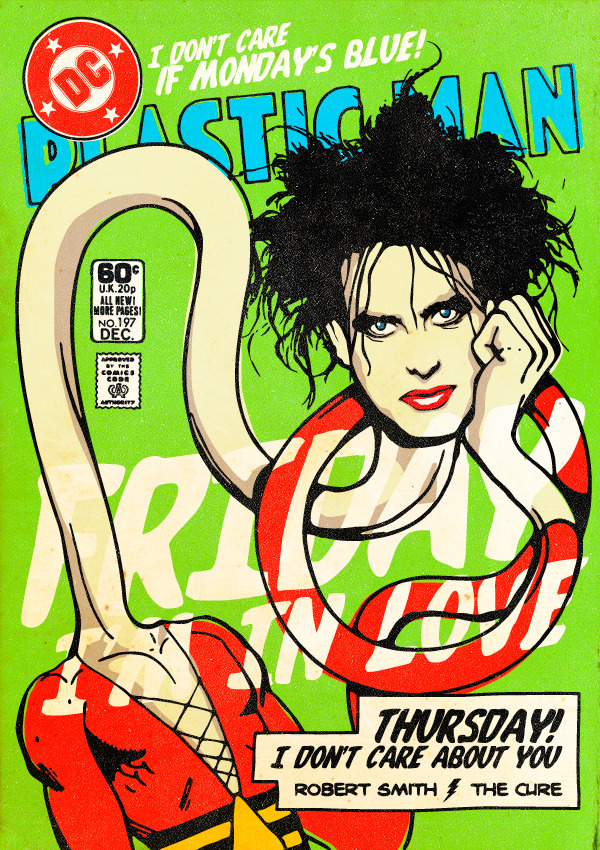
2013 “The Post-Punk / New Wave Plastic Man by Butcher Billy”

Click To Enlarge


What makes a pop culture icon?

"Would it be the effect of their contribution to a cultural movement? Is it the way they impact the time and the generation they are targeting? Or just how their exposure constitutes a defining characteristic of a given society or era?

As a child of the 80's I was heavily influenced by everything from saturday morning cartoons on TV to the music coming from the radio. Ian Curtis or Johnny Rotten are as iconic to me as Superman or Batman. Real people or imaginary characters, the incorruptible ideals of perfect superheroes or the human flaws and desires sometimes so desperately depicted in song lyrics - all of those influences affect us to the point of defining our character and personality, career paths and life choices.

The references we are exposed and specifically the ones we choose to absorb make us who we are. Who are your heroes?"
I really, really like most of Butcher Billy's choices for amalgamations, and I suppose Robert Smith's theatrically exaggerated personal style (specifically the epic hair) lends itself to Plastic Man. Still, we could have done better here. With the perpetual thick glasses and sardonic humor, "Eel" O'Brian and Elvis Costello might as well be relatives. As for repurposed lyrics, might I suggest "We slip through the streets, While everyone sleeps. Getting bigger and sleeker and wider and brighter." Regardless, I love each of the combined subjects, and am grateful for a straight Pliable Paladin instead of that goddamned Grant Morrison Jim Carrey crap. This a swell image that's I'd totally hang on the wall!

The Post-Punk / New Wave Super Friends

Friday, July 6, 2012

2012 “JLA Jan. - Plastic Man - 204” art by Robert Q. Atkins

Click To Enlarge


"Like I was saying with Captain Marvel from the other day, DC Comic's superheroes come in all forms, and no one more literally than Plastic Man! My earliest memory of Plastic Man was an old VHS tape with a few cartoon episodes on it. It was a show that ran for a couple years from 1979-1981 called "The Plastic Man Comedy/Adventure Show!" This show was awesomely ridiculous. Just the tone of the show and the fact that he had a polynesian sidekick named Hula-Hula, it all made the show lived up to it's name.

In the comics I haven't read much with him in it. But one of the most memorable JLA issues I read from the Joe Kelly/ Doug Mahnke run on the book was a team up with Plastic Man and Batman. It was a great example of the range of characters in the JLA. Over all I really liked how Joe Kelly wrote the character in his run, he seemed to nail the humor just right."
JLA Jan

Tuesday, April 3, 2012

1979 The Plastic Man Comedy/Adventure Show Opening Theme


All my life, there's been comics. I was cool with cartoons like most kids, but comics always came first. That's how I could tell the real comic book super-heroes from the "fakes" like the Blue Falcon, Mightor, Space Ghost, and Birdman. That's also how I knew Plastic Man was a "real" super-hero, but a Benedict Arnold who acted like the worst kind of fake.


First off, until someone takes Hack/Slash to animation, a forward slash in a title does not sound like good cartooning. Second, the title announces itself as "comedy/adventure," which is fine if you're Big Trouble in Little China and both come naturally. Typically though, it just means the "laughs" are tepid and the action isn't taken seriously, as was the case here. Third, the cartoon continued the huge mistake perpetuated since DC started publishing Plastic Man in the '60s of treating Plas as a zany oddball in a straight world. It pretty much kills any dramatic heft or depth in the character, and in more recent years has rendered him the most noxious of obs. The original Jack Cole comics are so great because Plas is the heroic straight man in an insane world of catastrophe, heinous deeds, and nutty scams. You're glad the Pliable Paladin has the flexibility to bend around and contain the crushing weight of man's inequities. In the cartoon, Plastic Man is just an annoying dork trying way too hard to be funny and failing miserably. Fourth, the cartoon traded sleazy hustler Woozy Winks for the klutzy pinhead Lou Costello impersonator token sidekick Hula-Hula. Fifth, they saddled Plas with the Southern Belle bimbo Sue Dibny wannabe Penny who produced Baby Plas, who in itself was the six-six-sixth. Finally*, they had that absolutely wretched live action Plastic Man for interstitials during cartoons, even though his voice in no way matched that of the animated Plas, and he was so sleazy that he made you want to punch his face off. I watched some of his work before writing this, and all these years later, I still want to commit acts of violence upon this person, just to make him stop talking.

I suppose the point of all that was to say that I hate The Plastic Man Comedy/Adventure Show more than most any other super-hero cartoon and I've hated it longer than most anything else in this life. I'm not sure which I heard of first-- this show or Nazis. I think I've hated this show longer than the concept of an (admittedly stylishly dressed) army of real life genocidal madmen who murdered millions. It also made me hate Plastic Man for many years, but the character is much cooler than this, so please try to forgive him for having a bad show that somehow managed 130 episodes in two seasons.

While I've got you here, I'll throw in the opening to 1980's The Kid Super Power Hour with Shazam! Only thirteen episodes were produced, so unlike Plastic Man, there weren't enough to re-run consistently in syndication throughout my freakin' childhood. In fact, I maybe caught this show once or twice as a kid, and the rest was on YouTube as an adult who didn't get much out of them. Still, Captain Marvel's another fun character who once was among the big guns, but DC rarely gets them remotely right after decades of ownership...


*Okay, one more-- a jet? Who thought a jet was a good idea?

Wednesday, March 14, 2012

2012 DCU Movie Fan Casting: Joseph Gordon-Levitt as Plastic Man


Ever since the brilliant Brick, Joseph Gordon-Levitt has steadily become one of my favorite actors. The kid has range and emotional depth, as demonstrated relatively recently in 50/50. He was in the running for my fan cast of Ray Palmer, because the guy is clearly intelligent, but he's quite simply too cool to fit the part of the Atom. I've been waiting for just the right role, and finally made the perfect connection-- Plastic Man!

Those who were first exposed to the character by Grant Morrison's JLA might take issue with that, as the character was treated there as broadly obnoxious "comic relief" in the mold of Jim Carrey's "Ace Venture." Frankly, DC Comics have yet to get the character remotely right, from forgetting they owned him in the '50s (see: Elongated Man) through to his terrible attempts to cash in on media trends in the '60s-'70s, and his descent into irrelevance in the '80s & '90s.

The fact is, Jack Cole's Plastic Man was a sharp detective and all around nifty gent dealing with a mad world and his own legitimately funny bumbling hustler sidekick Woozy Winks. The classic Plas stories of the '40s & '50s are among the finest produced in the Golden Age, and if DC had any sense, we'd have seen Gail Simone in full Birds of Prey/Secret Six nasty mode paired with Ethan Van Sciver on the Pliable Paladin instead of Firestorm.

Years ago, the Wachowskis tried to do a movie with Keanu Reeves in the role, and while that's closer to the mark than we've seen in years, I think you need someone with a lot more charisma. Gordon-Levitt can be funny, cunning, sexy, and charming in the right portions for Eel O'Brian. Given his boyishness and slight frame, there aren't many proper super-hero roles suited for Gordon-Levitt, so I really do think this is the best marriage for the property and the actor, should he ever want to take a turn in spandex.


Diabolic Movie Fan Casting

Tuesday, August 9, 2011

Who's Dat: Stretcho, the India Rubber Man


PERSONAL DATA
Real Name: Unknown
Occupation: Carnival Freak
Marital Status: Unknown
Known Relatives: None
Group Affiliation: None
Base of Operations: Mobile
Height/Build: Variable, with an average build
Eyes: Black
Hair: Black
First Appearance: Police Comics #69 (August, 1947)

HISTORY
Stretcho was part of a touring carnival that made its way to Plastic Man's town. Working as an attraction, Stretcho supplemented his income by using his abilities to pick pockets during his shows. Two crooks named Reggie and Monk had just been released from prison, and had already made one attempt on the life of the fellow who put them there, Plastic Man. Escaping capture to the carnival, the thieves caught Stretcho in the act, and competed with him over who would rob Wall Street Wells, the Millionaire Gambler. Plastic Man arrived to bust his would-be killers, but Stretcho took offense at Plas horning in on his act, and an elastic fight ensued. Despite his bungling sidekick Woozy Winks' unfortunate "help," Plas managed to knock Stretcho clear across the carnival.

During the melee, Reggie and Monk had made another break, but approached the sore Stretcho with the proposition of framing Plastic Man. Following through, Stretcho disguised himself as Plas and began cutting the lines on a parachute drop partaken of by Wall Street Wells. The real Plas responded to Wells' cries for help, lowering him to safety as a makeshift parachute. Plastic Man fell on top of Reggie and Monk, covering them while using a free arm to choke the disguised Stretcho. Clearly no true match for the real thing, Stretcho was tied up in knots and turned over to authorities.

POWERS & WEAPONS:
Stretcho appeared to have powers of elongation comparable to Plastic Man, but did not take on any complex shapes, or otherwise stretch his abilities to the degree seen by others with the same power set.

Quote:
"Beat it, you amateur! This is a closed shop!"

Created by: Jack Cole

Saturday, February 12, 2011

2010 Super Powers Plastic Man LithoPrint


This eBay find is probably about as legit as Eel O'Brian, but it isn't like DC Direct is going to knock out a twenty buck poster featuring swell Plastic Man stock art anytime ever as long as we both shall live.

Tuesday, February 8, 2011

Who's Dat: Hate


PERSONAL DATA
Alter Ego: Hate
Occupation: Crime Enthusiast
Marital Status: Unknown
Known Relatives: None
Group Affiliation: None
Base of Operations: Mobile
Eyes: Pure white
Hair: White
First Appearance: Plastic Man #5 (Autumn, 1946)

HISTORY
Within a book called Evil Knowledge there exists a spell involving the burning of phosphorus and sulphur [sic] while speaking the words “Abraxas--- sator arepo tenet---.“ The incantation would invoke the mysterious being called Hate, something of a genie who would grant malevolent wishes.

The book was once found by a nebbish named Mr. Giglamp in a used book store, who decided to perform the ritual in the belief that it was a recipe. Hate passed by Mr. Giglamp’s window, and asking what the fellow would like most in the world, Hate awarded him a fistful of money. “That and more, if you want it! You read the words and burned the materials… I’ve waited a long time to be called!” Mr. Giglamp was happy with how things turned out, and was open to doing Hate another favor whenever he needed it. Hate made it clear Giglamp had plenty more to do, whether he liked it or not. “I’m not satisfied with the way certain professions are being run! Crime, for instance… Bungling idiots practice it! You shall carry out my enthusiasms! I have plenty of connections! Do as I say and you’ll go far!”

The diminutive Giglamp showed up at the hideout of the Rickens gang, whose leader had just gotten out of jail after having been pinched by Plastic Man. Hate trailed behind, seemingly invisible, urging Giglamp on. Hate gave Giglamp a hypodermic shot in the arm that made him “invulnerable—powerful—merciless,” which was used to flatten a burly gang member. Hate then gave the rest of the gang a shot that had the opposite effect, “weakens and confuses!” It was no work at all to show Rickens the door, allowing Giglamp to take over the gang.

Giglamp led the burglars to rob the Jewel Museum of the priceless Crown of Cleopatra. This was accomplished by stealing one guard’s uniform, and then having swift crime tailors doctor up a replica set for the gang to wear. However, Plastic Man and Woozy Winks had been following Rickens since his release, and questioned the still dizzy thug after his ejection. Plas made his way to the museum, and threatened one phony guard with drowning to extract information, but the rest of the gang got away.

Hate left Giglamp to his own devices for a bit, as the nerd relished counting the loot with his gang. Rickens showed up, hoping for a cut from the heist that had been his idea, but he was turned away. However, Plastic Man was hidden behind Rickens, and acted as his discreet enforcer in collecting the ill-gotten gains. While Plastic Man ensnared the lot until a paddy wagon could arrive, Woozy Winks followed Giglamp back to his home.

As Giglamp tried to perform the incantation from memory, Woozy stole the book of evil knowledge and read the same incantation backwards. Giglamp choked on a red gas that emitted from his lamp, then wandered off into the street. Woozy gave the book to Plastic Man, who while not necessarily superstitious, still chose to chuck it into the harbor waters.

Without being called, Hate found Giglamp hiding in an alley. Hate had no use for failures, and with the book destroyed, believed this would probably be his last appearance. Before he went though, he caused Giglamp to die of fear. Police found no marks on the body, and Plastic Man chalked it up to suicide, “in a manner of speaking…”

POWERS & WEAPONS:
Hate carried a stout hypodermic needle that could enhance or weaken people with a shot.

Created by: Jack Cole

Wednesday, January 26, 2011

Who's Dat : The Crab


PERSONAL DATA
Alter Ego: Bunk Norton
Occupation: Crooked Entrepreneur
Marital Status: Unknown
Known Relatives: None
Group Affiliation: None
Base of Operations: Norton Amusement Pier
First Appearance: Police Comics #63 (February, 1947)

HISTORY
Bunk Norton ran scams before being sent to prison by Plastic Man (disguised as a red setter with yellow and black stripes.) Norton stewed in the pen through the best years of his life, learning never to smile and to imagine himself with a protective shell around him. Norton came to appreciate crabs for their toughness, defense mechanisms, and slow but calculated movements. Norton was himself apple-bodied with long lean appendages, a bald head, and jagged teeth. Combined with his fascination with crustaceans, Norton picked up the nickname “The Crab.”

After his release from prison, the Norton Amusement Pier went into full swing, without much attempt to conceal the criminal activities within. Folks might win a hundred grand at the Casino Faro, but there was sure to be a blackguard waiting to rob anyone who got too lucky, and turn the loot over to the Crab. Anyone who complained wouldn’t get further than one of Norton’s other goons in the company offices, too wound up in tossing through girlie magazines to take notice.

One night, Plastic Man decided to investigate the pier, and ran into his sidekick Woozy Winks. Woozy had parlayed his pool skills into winnings enough to have an attractive girl in each arm and cash sticking out of every pocket. Plastic Man looked on discretely as the girls helped distract Woozy from pickpockets, and silently observed another fellow robbed at gunpoint. Plas took note of the victims’ names and losses so that their money could be returned once his investigation was completed.

While concealed as a bust on an office mantle, Plastic Man observed the Crab hold a hireling named Lefty’s hands together behind his back as he lifted Lefty’s arms well over his head, and ground his feet into the man’s back. This torture technique was used when Lefty tried to hold back money, and after it was retrieved, he was tossed out a door opening directly on the water. Plastic Man rushed to save Lefty, who couldn’t swim, but the fellow died of a heart attack induced by fear at the site of crabs in the water.

Almost immediately, all the lights and rides on the pier were shut down, and all of the patrons were shuffled off. Woozy Winks stayed behind to complain that he had been robbed, and wound up diving in the river, trying to retrieve a quarter. Plastic Man dove in after him, and both discovered that the Crab had a secret underwater headquarters. Woozy wanted to continue after his money, but Plastic Man sent him to dry out so that he could address Norton’s more serious crimes.

Norton was with the two women that had helped to bilk Woozy, and slapped one for failing to notify him that she had seen Plastic Man earlier that evening. The other lady hoped to changed the subject to avoid being hit herself by pointing out the large red fish watching them from a porthole. The Crab noticed the fish’s yellow and black stripes, and used the suction from the opening of an antechamber to draw Plastic Man into a trap. As it turned out, Norton enjoyed starving crabs until he could make them eat anything, even an India rubber man.

Woozy Winks had been searching Norton’s offices for his money, and stumbled upon a secret elevator. Woozy accidentally locked himself inside, but also Norton without. The Crab stopped laughing in the face of Plastic Man’s pain to try forcing his way through his elevator’s gates. Meanwhile, the Pliable Paladin stretched to open a hatch to the water outside, flooding the secret headquarters. Plas then worked his way out of his cage and on into the elevator, then managed to open the gate’s lock. While the heroes escorted the ladies to safety before water fouled the elevator’s cables, Norton was left to be eaten alive by his pet crabs. The Crab’s smut loving henchman Rick soon agreed to help Plastic Man retrieve Norton’s ill-gotten gains and see them back to their proper owners.

POWERS & WEAPONS:
The Crab was quite tall and exceptionally strong, but did not appear to possess any superhuman powers. His teeth were all sharpened, making him resemble a piranha.

Quote:
I don’t consider it an insult to be called a crab… I admire crabs! They’re smart! They move slowly, but they get what they’re after! And did you ever see a crab eat a victim once he got him?”

Created by: Jack Cole

Tuesday, January 25, 2011

Justice #9 (February, 2007)


Previously in Justice...

The Legion of Doom found "It's time to wake up. They are all having the same dream. Over and over again. Every one of them. All so humanity will survive these creatures of tomorrow."

The super-villain's plot to destroy the super friends unfolded...

The news media was all over it...

Bizarro burst through the ceiling of Clark Kent's apartment, and pulled Superman out to fight in the steets of Metropolis...

In no time, the Power of Shazam was at Superman's disposal.

John Stewart was searching for Hal Jordan

Once again, the Wisdom of Solomon trumped any thoughts in Superman's head.

In an Arabian desert, the Flash broke up Captain Cold's mini-harem.

"With a word, I become the world's mightiest mortal. With a whisper, the thunders call my name. I am Captain Marvel. And in the infinity of possible retaliations against Brainiac and Luthor and their cohorts that we could make this day, there is only one that is perfect. Only one that is just.

All words are magic. That is the beginning of wisdom. Secret words open and close doors. They are like keys. That's how our names and identities have been used to endanger those we love the most. That's why a promise to heal has ensnared the world."

Not a bad bit of monologue, but this comic is basically as dumb as Metamorpho, so it won't pan out. "I don't understand. But then, I usually don't." Well Metamorpho, the world has been taken over by good deeds done with bad intentions, in no small part helped by mind-controlling synthetic worms getting into people's brains. As Captain Marvel noted, the villains "could never naturally form this sort of alliance. They are criminals because of their inability to sustain any sort of community." Also, Hal Jordan wasn't killed by Sinestro because his power ring would have just gone to John Stewart, so better to stick him someplace out of the way. "I'm still working on my G.E.D. What is he saying?" Oh, Metamorpho.


Captain Marvel was magically transported to a battle against Gorilla Grodd where he was supposed to be protected from infection by Green Lantern's power ring. However, Black Adam was also on the scene, and lured the Big Red Cheese away by threatening the life of his sister. Of course, Mary Marvel was only playing possum, as she and Captain Marvel Junior were both in thrall to the worms. "You're so stupid, Billy. Where's your wisdom now? You left your friends." While Black Adam and Junior held Captain Marvel aloft, Mary Marvel returned the power of Shazam, and began falling to her inevitable death. Adam wanted Captain Marvel to "Say the magic word." With tears in his eyes, Marvel asked, "...please..." Adam sneered, "That's not it."

The World's Mightiest Mortal broke free with the strength of Hercules, then flew after Mary with the speed of Mercury. Mary again called down the thunder, striking Captain Marvel. The champion of Shazam landed with a thud, as he could no longer hear the gods whispering their powers to him, for he was now worm food.

Under the direction of Batman, the Atom and Doc Magnus, the Flash constructed suits of armor for the Justice League to wear as protection from the worms. That hadn't done Captain Marvel any good, as he began slamming into the outer walls of the Fortress of Solitude. Asking why would require a wisdom he now clearly lacked. Even Captain Marvel couldn't take on all the collected heroes on his own, so why not front an army of super-villains, if they knew where the League was located? Why knock, when Marvel should be strong enough to pick up Superman's key? If not, how about if Black Adam and the Marvel Family had been in tow? No, we would instead have another one-on-one fight with an (unprotected) Superman, until Captain Marvel was captured by Green Lantern, and his worms removed. Useless tangent? Deux ex machina? You be the judge.


Hal Jordan and Captain Marvel were sent by Batman to Arkham Asylum, where they found that Dr. Sivana, inventor of the worms, had been locked up by Brainiac. Why? Stop--using--wisdom--readers!

Most of the Justice League donned their armors, including Green Arrow and Plastic Man, but not the absent Captain Marvel. Meanwhile, Metamorpho managed to defeat Gorilla Grodd by becoming a gas and choking the Super-Gorilla before he even knew the Element Man was present... and Rex even managed to steal a yellow power ring. Who's wise now?

"Chapter Nine" was plotted and painted by Alex Ross. The script was provided by Jim Krueger, and the penciled layouts by Doug Braithwaite.

Continue the story through these character-specific posts:

Monday, January 24, 2011

Plastic Man Postcard by Ethan Van Sciver


Looking back on my childhood memories, I do believe Plastic Man was the first super-hero I actually hated. In fact, I wasn't even 100% sure he was a "real" super-hero at first. You see, I loved almost all the super-hero cartoons featuring Batman, Spider-Man, Captain America, Superman and so forth. Those guys were very much in the comic book mode, especially the '60s Marvel ones where they literally cut up and barely animated actual comic book art. Then there were all those tongue-in-cheek pretenders the cartoon studios trotted out, like the Blue Falcon, Atom Ant and the rest of those big fakers who were still riffing on Batmania over a decade after it died. I made allowances for the ones who took the work seriously, like Space Ghost and Birdman, even though I knew they weren't proper comic book adaptations. Like Jules Feiffer, I resented super-heroes that got too cheeky, as though they were mocking myself and the other kid viewers who wanted legit super-hero action, and Plastic Man was the biggest traitor of the bunch.

You see, even though it would be years before I read a Plastic Man comic book story, the cartoon made it clear that he was in fact a DC Comics character, and it also made it plain that he sucked. Like a one man Impossibles, Plas could basically become anything, was never in physical danger, and generally employed wimpy non-violent methods of fighting crime. While regular super-heroes had a decent supporting cast, Plastic Man had that klutzy idiot Hula-Hula that was never not annoying. His girlfriend Penny's primary charm was lost of a prepubescent, not that she would be my type even now, and boys only have so much tolerance for incessantly distressed damsels. Plastic Man had the worst villains, and then they went and added Baby Plas, because kids love watching shows about new fathers and the trouble their super-powered infants get up to.

The Plastic Man Comedy/Adventure Show was an anthology like Space Stars, and while I was never a huge fan of The Herculoids or the Galaxy Trio, they were still alright. Not only was the Plastic Man cartoon itself terrible, but it was "supported" by absolute crap like Rickety Rocket, Fangface and Mighty Man & Yukk. However, even taking all that into consideration, the very worst aspect of the show was the live-action inserts in which a smirking, smarmy, terribly unfunny actor played Plastic Man as the show's "host." That guy made the Nicholas Hammond Spider-Man look like the George Reeves Superman.

Probably the first Plastic Man stories I read were in Adventure Comics, and they weren't much better than the show. Plas would turn up here and there over the years, but I think it says something that even when Justice League was desperate for name characters in its post-Legends relaunch, nobody bothered with Plas. There have been numerous attempts at "funny" Plastic Man specials, mini-series and even an ongoing, and speaking as a guy who loved Ambush Bug and Blue Devil, I just couldn't see the appeal. Those books were all bland sitcoms masquerading as comics, like adapting the tired television super-hero parodies back into the books themselves.

I did buy a Plastic Man Super Powers Collection action figure, but only because it was so cheap for so long in the discount bin, I finally took pity on it. He was useful when other toys needed someone to beat up. I was always losing action figures to thieving kids in my neighborhood, but no one ever stole Plas. He was still in my collection until my brother lost every single one of my figures at some camp for juvenile delinquents he went to. I bet some pre-teen kleptomaniac looked at that Plastic Man and realized he must have a serious problem if it had come to this.

In the late '90s, someone finally decided the character was historically significant, and then Grant Morrison went and added him as the "trickster god" in his vision of a pantheistic JLA that pretty much marked the point where his run started limping. Morrison thought it would be brilliant to recast Plas in the Jim Carrey mold, problem because he was really high during an Ace Ventura: Pet Detective/The Mask double feature. Plas became the gratingly obnoxious ass intended to offer "comic relief," which was usually related to ancient Warner Brothers sight gags and the sexual harassment of super-heroines. In searching the internet for art to go with this piece, I came across no shortage of both, and I feel the twenty-fifth image of a partially disrobed Wonder Woman choking a perverted Plas really drove home how pathetic the character has become.

My history with Plastic Man was toxic, and one punishing comic appearances after another stoked that earliest childhood hatred across three decades. A funny thing happened in 2001, though. I was convinced by solicitation copy to read Jack Cole and Plastic Man: Forms Stretched to Their Limits by Art Spiegelman. The book was part biography of the creator, part history of the character, plus classic reprints and a look at cultural impact/artifacts, all of it presented through the graphic design artistry of Chip Kidd. The whole production was outstanding, and completely changed my perspective on Plastic Man. I followed that up by reading old school essays on Plas by guys familiar with the original material, and then made sure to sample Jack Cole's work myself, and realized why it's considered one of the high points of the Golden Age.

I now realize that Plastic Man is one of the truly under-appreciated gems among super-heroes, with classic stories potent enough to outlive most of his '40s contemporaries, making it a month into the Silver Age before his publisher sold out to DC (who in turn sold out the character.) I don't hate the Plastic Man, only DC's inability to write the character remotely correct. You see, Plastic Man is not an all-ages goofy character. He's the straight man with a kinky body meant to navigate a thoroughly crooked world. The old comics are filled with dark humor and dirty deeds committed by delightfully wicked n'er-do-wells. Plas is himself an ex-crook who still pals around with the opportunistic Woozy Winks and busts gun-runners, sweatshops run on child labor, diabolical entities, and so forth. Plastic Man is relevant, sexy, and cool in hindsight, and it's only the minds of his writers that got small.

There's a reasonable amount of decent art of cartoony Plastic Man on the internet, both geared for kids and arrested development cases. However, I went to the trouble of coloring and otherwise enhancing an Ethan Van Sciver convention sketch for this "postcard" because he seems to be the only illustrator out there who "gets" the character. Plas may be malleable, but there's handsome heroic features and an underlying anatomy in Van Sciver's interpretation. The Pliable Paladin needs someone who can bring back the serio-comic elements of Cole's awesome comics. I can't think of any writer better than Gail Simone to join Van Sciver in playing up the contrast between the necessary humor of Plastic Man with the darkness and complexity of his world, the latter having been completely forgotten over the years. Rumors have placed both creators on a prospective project in some dim future, and if there's any justice in this industry, it'll be Plastic Man.

Thursday, January 20, 2011

Who's Dat: Weapons


PERSONAL DATA
Real Name: Unknown
Occupation: Weapons development and trafficking
Marital Status: Unknown
Known Relatives: None
Group Affiliation: None
First Appearance: PLASTIC MAN #5 (Autumn, 1946)


HISTORY

Weapons was a "merciless wizard who created tools of death for a murder-mad underworld!" Initially working with the Grub Street Gang, Weapons made "an amazing improvement in automatic firing" which seemed to bridge the classic Thompson submachine gun of the prohibition era with later full automatics. The advanced firearm came to the attention of Plastic Man when it was used against federal officers as they attempted to raid the gang's lair. Unable to silence a gunman while entering the hideout through a window, Plastic Man saw the fellow gunned down by his compatriots, distracting them long enough for G-men to storm in and wipe out the gang.

The mobster Jimalong was impressed with Weapons' gear, but wanted improvements, and the addition of a high-powered grenade launcher seemed to do the trick. However, Jimalong never arranged an exclusivity agreement, so Weapons sought out his rival Hoopsnake and began profiting from arming both gangs. However, Plastic Man was allowed to examine one of the Grub Street Gang's confiscated rifles, and after breaking it down, found it required a specific type of spring specially made by a single known vendor. Unfortunately, that lead never bore fruit.

Gang warfare broke out in the streets, and Plastic Man was able to partially interrogate a participant before the gangster was shot in the back with a grenade. Weapons was also on the scene to observe his creations in action, and began spying on his pursuer. The Ductile Detective swiftly eliminated several possible work spaces for the arms' production, and zeroing in on a correct location, was the subject of an attempted assassination by Weapons. Failing that, Weapons returned to his lair, Plastic Man and his sidekick Woozy Winks close behind. While the pair were forced to overcome a gauntlet of traps within Weapons' house, Plastic Man eventually caught his man. However, Weapons chose death over confinement, and killed himself by smoking an explosive cigar.


POWERS & WEAPONS:
Besides his grenade launching machine gun, Weapons thoroughly fortified his home with devices acquired and of his own invention. These included a trap door leading to a nearby waterfall, a photo-electric cell triggered machine gun battery secreted behind wall panels, bombs, a swinging guillotine, a "multiple knife thrower," a rifle with a barrel designed to shoot around corners, a battle axe, and a disintegrator ray. Weapons ended his life with a cigar that would fire a bullet into the smoker's mouth five minutes after being lit.

Quote:
"I don't like that chap! He's too selective-- too critical! If he sees many more wrong answers, he'll find the right one!"

Created by: Jack Cole

Tuesday, January 11, 2011

DC Owns?


A few months back, I was inspired by the appearance of Peter Cannon in DCU: Legacies #5 to look at what characters DC has assumed ownership of over the years, as well as to consider the tendency for the company to treat their acquisitions as red-headed stepchildren (which recalls their dalliances with Archie's super-heroes, actually.)

Until the 1970s, DC Comics was technically known as National Periodical Publications, derived from the Malcolm Wheeler-Nicholson's offering New Fun Comics under the banner of National Allied Publications. Harry Donenfeld and Jack Liebowitz, the guys who would really end up running National, came into the picture with Detective Comics. Wheeler-Nicholson was forced out after a bankruptcy, and the core DC super-hero universe began with Superman, Batman and Robin, plus lesser lights like Dr. Occult, Crimson Avenger, the Sandman, the Spectre, Hourman, and Dr. Fate.

Meanwhile, Donenfeld set up a side company with Charlie Gaines called All-American Publications in 1939. This was the birthing place of Wonder Woman, the Flash, Green Lantern, Hawkman and most of the rest of the Justice Society of America (including the team itself.) This represents the first schism in the DC Universe, because history bears out that their "World's Finest" was long the trio of Superman, Batman and Robin, leaving Wonder Woman and company as the other guys. In fact, for a brief period in 1945, All-American had its own separate "AA" cover logo, but when Gaines sold his stake later in the year, the line was folded into National. Think about this: While latecomer National back-up players like Aquaman and Green Arrow managed to stay in print throughout the Silver Age, the headlining stars of the All-American line were out of print by 1951. The one exception was Wonder Woman, but it didn't help that her co-creator William Moulton Marston and his estate retained certain rights to that character long after his death.

National bought the Quality Comics stable in 1956, and couldn't even be bothered to maintain their copyrights afterward, allowing scores of characters to enter the public domain. Plastic Man was one of the few super-heroes to survive the Golden Age, but National blew off continuing his title and buried him so deep in their portfolio that one of their own editors created a rip-off in 1960 without knowing he could have resurrected the original. National finally brought Plastic Man back for the first of many underwhelming revivals in 1966, not a single one lasting even two years. The other super-heroes pop up now and again, usually under the Freedom Fighters banner. National did continue publishing some of Quality's war titles, the most prominent star being Blackhawk, whom they spent most of the '60s updating and revising to the point of farce, until finally killing the book before decade's end.

After incessant lawsuits levied by National kept the best-selling Marvel Family of titles from being fully exploited through merchandising and media, plus the downturn in the super-hero industry after World War II, Fawcett Comics finally settled and closed down its comic line in 1953. Twenty years later, National began licensing their characters as add-ons to the DC Universe. In the interim, National had hired Captain Marvel's creators to largely recast Superman in the image of Shazam, building his own family and borrowing the lighter tone. By 1973, not only was Captain Marvel out of step with the times, but much of what had made his family unique was now associated with the Man of Steel. Plus, honestly, National couldn't have ever worked out a deal to buy the Captain Marvel trademark from Marvel Comics if it really mattered to them? I think not. DC didn't even acquire all the rights to the Fawcett properties until 1991, about the time they launched the most successful revival of Captain Marvel to date, four years worth of the mediocre The Power of Shazam!

In 1983, DC bought a batch of Charlton Comics "Action Heroes" at fire sale prices. Probably because a former Charlton editor was in senior management at DC, the short-lived and unsuccessful characters were treated with more respect than most once at DC. It probably didn't hurt that Charlton was never a serious competitor of DC's, and that the company had a much greater leeway to reinterpret the characters for modern times. Captain Atom had a healthier run in his solo series than Captain Marvel at DC, and the Question showed more staying power than Plastic Man. It's important to not that DC did not buy the Charlton name nor all of its assets. Aside from the aforementioned heroes, DC also has Blue Beetle, Nightshade, Peacemaker, Judomaster, Sarge Steel and their associated supporting casts/villains. DC only held the rights to Peter Cannon, Thunderbolt until 1993. Thunderbolt's creator, Pete Morisi, had asserted that he owned the character, not Charlton, and an agreement saw the rights revert back to him after a last failed attempt at a solo series. Morisi passed away in 2003, and one would expect DC to trumpet the reacquisition of the character from his estate, had they done so. Therefore, it's safe to assume Peter Cannon's appearance in a 2010 title was either an oversight or a single usage deal.

In 1991, DC Comics licensed the MLJ/Red Circle super-heroes once published by Archie Comics. The !mpact line that followed was a commercial dud that folded within two years. In 2008, a second, smaller scale licensing revival was attempted under the Red Circle banner, this time incorporating the Archie super-heroes into the DC Universe. This also folded within two years, and DC does not own the rights to any of the Archie heroes.

Milestone Media was created in 1993 as a partnership with DC Comics. However, DC does not own any of the Milestone characters. Instead, they have what amounts to an exclusive licensing agreement to publish Milestone characters, while Milestone Media retains all copyrights and creative control.

WildStorm Productions launched in 1992, and sold out to DC in 1999. The line featured cutting edge writers and artists who were then pillaged by other companies or alienated by the heavy-handed management at DC. Their core books were rebooted as a severely mishandled new universe in 2006, and finally folded entirely in 2010.

In 2009, DC announced that they had bought the rights to the T.H.U.N.D.E.R. Agents from John Carbonaro before he passed away that same year. However, the rights to those characters were disputed in court throughout the 1980s. There was a longstanding argument that the failure of publisher Tower Comics to secure copyright on their characters in their first issue meant they were in the public domain. Carbonaro was a tenacious plaintiff though, and fought for years to shore up his exclusive ownership of the properties. Funnily enough, Archie Comics licensed the characters during one of their super-hero line revivals, and Carbonaro danced with a great many publishers before establishing a (sometimes rocky) relationship with DC in recent years.

Hopefully, this piece helps to clear up lingering questions of who owns what. I think it also makes a case for how the company tends to segregate its acquisitions and show greatly preferential treatment to its in-house creations.